Showing posts with label eastern bluebird. Show all posts

Wednesday, October 28, 2015

The Reappearance of the Bluebirds - Part I

Text and photos © 2015 Adele Wilson, author of Bonding with the Barn Swallows

As you might remember, my neighbor mounted a Bluebird nest box in our yard last spring.  By the first week of July, four Bluebird babies had hatched in the box.  On the morning of July 22nd, I knew that the babies were due to leave the nest soon. 

Fortunately, it was sunny and clear that morning; so I went outside and took numerous photos of the parents feeding the babies inside the box.  A couple of the photos even showed a baby or two peeking out of the nest box hole.

That evening, to my great dismay, there were no Bluebirds around the box or its vicinity!  I checked the inside of the box and found no babies there.  The nest was compressed and quite unsanitary looking. 

Apparently, the babies had left the nest box (fledged) some time that day.  I was unprepared for this because I had calculated that the following day would be fledging day and I would have one more day to photograph the babies peeking out of the box.

Prior to this past July, my experience with observing baby birds in a nest had been limited to Barn Swallows, as I have described in my book, Bonding with the Barn Swallows.

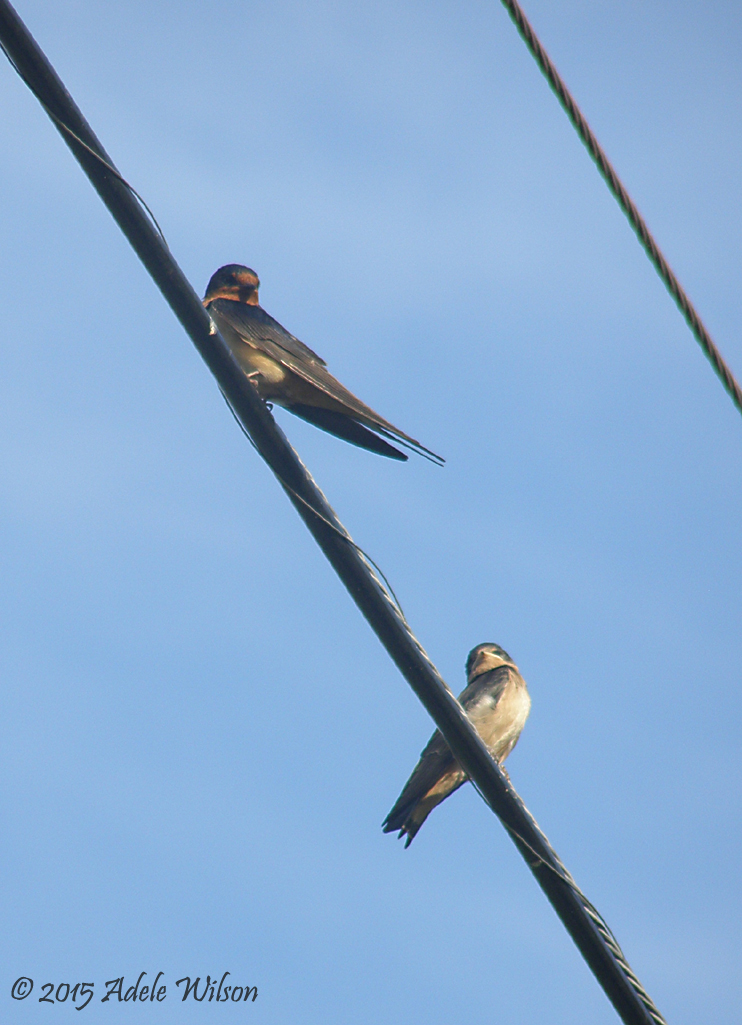
Unlike baby Bluebirds, Barn Swallow babies, once they fledge, remain in the vicinity of their nest.  In the days following the fledging of Barn Swallow babies, I have often seen them high in the air, quickly flapping their wings as they practice flying.  They will often line up on the utility wires to rest and wait to be fed by their obliging parents.

Also unlike baby Bluebirds, baby Barn Swallows who have fledged during the morning will often return to the nest that night in order to rest from their long day.  Below is a photo from page 102 of my book, showing two baby Barn Swallows after they had returned to the nest the evening of the day that they fledged.  They looked so worn out that I thought they were about to expire!


To my great relief, however, after an hour had passed, the babies were sitting upright in the nest, looking like normal baby Barn Swallows.  They left the nest for good the following morning. 

But baby Bluebirds are “here today, gone tomorrow”.  They do not return to their nest once they have left it.  Their parents usher them into the trees for safety from predators.  Unable to feed themselves, the babies must depend on their parents to bring them insects for at least the next two weeks, just as the parents do while the babies are still in the nest.

I would have liked to have witnessed the fledging of the baby Bluebirds as an assurance that all four babies had made it out of the box safely.  We have a number of roaming, feral cats around here, and I was quite concerned that one or more of the babies had landed on the ground, making them vulnerable to predation.

A couple of mornings after fledging day, still not having seen any Bluebirds around, adult or young, I cleaned and sanitized the nest box. I had read that Bluebirds can raise two or three broods per season and that it might not be too late in the summer for the parent Bluebirds to start another brood.  I had also read that a pair of Bluebirds likes to have their box clean and their old nest removed before they re-nest in the same box.
 
But the parent Bluebirds did not return to their nesting area.  In fact, I did not see them anywhere!

I began searching the grounds of the property where I live for any sign of Bluebird fledglings.  But they were nowhere to be found.  Then I remembered, as previously stated, that parent Bluebirds take their newly-fledged babies into the woods to hide them from predators.  I had also read that, if the mama Bluebird decides to build a new nest, she will proceed to the nesting site and do so, leaving the papa to feed the young birds and teach them how to hunt.

In an intense desire to find out how many babies had made it safely to their new home in the woods, I continued to search the property, paying close attention to the trees that border it.  Finally, on the morning of July 31st, nine days after fledging day, I spotted a Bluebird on the wire above the neighbor’s property across the road.  It appeared to be an adult male, but all I could get was a blurry photo, as shown on the left.

July turned into August, but still, no Bluebirds.  Where were they?  By August 6th, the two-week period of the fledglings’ dependence on their parents for food had passed.  Had the fledglings survived?  Were they now learning to hunt on their own?

At long last, on the morning of August 21st, 30 days after the Bluebird babies had fledged, I spotted a couple of Bluebirds on the fence at the far corner of the property. They were perching several feet from one another, apparently searching for insects on the ground.

One of the birds (see photo on right) had a considerable amount of blue on its back, along with a rust color on the side of its breast. However, its plumage was visibility mottled with small patches of white, showing that the bird was losing some of its feathers in preparation for growing new ones.  This process is called "molting".

The bird looked like it might have been a juvenile in the process of gaining its adult plumage.  However, if indeed a juvenile, it had not been hatched in our nest box because it appeared to be too mature.  Perhaps it was an older juvenile that had fledged from another nest, possibly in early June.  It displayed too much solid-colored plumage to have been be young enough to have been one of our babies.

The second bird (photo, below left) had a familiar look to it. At first I thought it was a juvenile because of the white spots on its breast. But, again, the bird definitely looked too mature to have been one of the babies that had left our box on July 22nd.

The familiar look was not from the bird's plumage. Rather, the bird’s fierce stance and alert personality jogged my memory. The bird was acting exactly as our mama bird had acted while her babies were in the nest – proud, yet vigilant, and seemingly prepared to attack anyone who would dare to venture close to her nest.

Could this possibly have been our mama bird in molt?  The white spots could be indicating that she had been shedding her summer coat in preparation for gaining her winter plumage. 

Suddenly, the bird left the fence and quickly flew to the utility wire on the other side of our building. I walked around the building to get a better view of it. The bird allowed me to get a couple of photos but remained in an alarmed and vigilant state, as you can see from the photo below:


Yes, this was definitely our mama bird!  It had the same slate-colored head and upper back as our mama.  In addition, her beak was relatively long in Bluebird terms.  Mama had apparently recognized me while I was photographing her on the fence and must have become alarmed that I might be a threat to her young ones.  It was as if she had flown up to the wire to get a better view of me to be certain that I was not there to harm her or the other Bluebirds. 

So the mama was still alive!  I was extraordinarily relieved and hopeful that she had done a good job of protecting her young.  Given my observations of her personality over the summer, I assumed that she had done just that! 

On the right is a photo of Mama Bluebird that I had taken on July 16th while her babies were still in the nest box.  She was holding a worm in preparation to feed the babies, and you can see how long her beak was. She was exhibiting the same stern and vigilant stance as exhibited by the bird on the wire. Her plumage was a little more colorful in this photo because she still had her summer coat.

The next evening (August 22nd), I noticed some birds perching on the distant wires across the hay field from my driveway (see photo below).  The wires extend from a prominent, yet distant, telephone pole.  My best count was seven birds. Although the birds looked like black dots to my naked eyes, my binoculars soon revealed that they were Bluebirds!


One by one, a Bluebird would occasionally leave its perch on the wire and quickly swoop down to the ground, far below, to gather an insect.  Having harvested its prey, it would usually return to the wire to devour the insect.  Once in a while, however, I would see a bird carry its insect from the ground to the top of the telephone pole to smash the insect and make it more digestible, just as our mama and papa Bluebirds had done this past summer in order to prepare food for the youngsters.

The birds on the wire whose plumage patterns I could discern appeared to be adults.  But, were some of the birds juveniles?  I wondered if the visual acuity of a immature Bluebird would be sharp enough to allow it to be able to see an insect on the ground from the distance of a high utility wire.  I did not witness any of the birds feeding another bird, which made me assume that, if juveniles were included on the wire, they were old enough to feed themselves.

The questions remained:  Did all four chicks fledge successfully from our nest box and were they still alive?


The next day, August 23rd, I again ventured to the far corner of the property to see if I could find any juvenile Bluebirds.  It had been one month and one day since the babies had left the nest, and I had not yet seen a bird that could have been one of them. 

Well, it must have been my lucky day because, as I approached the fence, I was delighted to see a bird perching there, and yes, it proved to be a young Bluebird!  And it appeared to be the age that one of our babies would have reached by that time.


The photo at the above right shows the bird's "pin feathers", revealing it to be a juvenile.  And, judging by the bright blue feathers on the edge of its wing and part of its tail, it appeared to be a male.

The following day (August 24th), during the late afternoon, I was still determined to find more juvenile Bluebirds, if possible.  And I was not to be disappointed!


This time I spotted a juvenile female, as shown on the right side of the photo above. This particular juvenile appeared to be a female because her plumage lacked the blue that the previous day's juvenile male had displayed. You can see that the Bluebird on the left side of the photo is much more brightly colored.

As for the brightly colored Bluebird on the left side of the above photo, I could not discern its age. Despite the rich hues of its plumage, there were white spots throughout, indicating that the bird was molting. This bird was most likely the same bird I had seen on August 21st. Again, I could only guess that it was an older juvenile that fledged in June from another nest.

That same morning, I was able to get another photo, shown below, of the brightly colored bird. this time perched on a high fence post.  What a beautiful bright blue was on its wings and back!

Part II will include a description of a special event that occurred in September and a revelation about the identity of one of the Bluebirds I spotted in August. You can follow this blog and be notified of the next post by entering your email address in the upper right corner.


http://www.amazon.com/gp/product/1494481464/ref=as_li_tl?ie=UTF8&camp=1789&creative=390957&creativeASIN=1494481464&linkCode=as2&tag=barnswalfrie-20&linkId=6IUTK4EYNGUVGU6H
If you have found this story interesting, you might want to check out my book, Bonding with the Barn Swallows. Its 117 photos include close-ups of the baby Barn Swallows that were hatched on my porch during 2011 and 2012. There are also photos of the parent swallows guarding the nest and feeding their young. As an extra bonus, the book includes photos of five different juvenile Barn Swallows, just ten days after fledging. You will be amazed at their varied markings. The book describes how one special male Barn Swallow communicated to me by his body language on the utility wire and how, only two days later, I discovered what he was trying to tell me. To find out more about the book and read a preview, just click on the image to the right.


Tuesday, July 28, 2015

Bye-bye Baby Bluebirds!

Text and photos © 2015 Adele Wilson, author of Bonding with the Barn Swallows


I don’t know why I get so attached to baby birds, but I’ve been that way all my life.  The baby Bluebirds left the nest box on Wednesday, July 22nd, and I haven’t seen them since.

I really didn’t see the babies at all except for their little heads peeking through the nest box hole the last few days during which they were in the box.  During that time, the parents had been extremely busy feeding larvae and full-grown insects to the babies through the box's entrance hole.

From my observations during the times that I had opened the nest box, I knew that the female had laid her last egg on June 21st.  The day the last egg is laid is generally said to be the day that the female begins incubating her eggs.  According to Cornell Lab of Ornithology, the average incubation period for Eastern Bluebirds is 14 days, but I had read that this period can be anywhere from 12 to 14 days.  The day that the first egg hatches is said to be the end of the incubation period.

Again, according to Cornell, the average number of days that Eastern Bluebird nestlings stay in the nest is 17 days, but I had read that it can be anywhere between 17 and 21 days, most likely 18.  When the babies leave the nest, they are said to “fledge”.  Therefore, the number of days that the nestlings stay in the nest is called the “fledging period”.

Also, in some cases, the female might begin to incubate on the day before the last egg is laid.  That would hasten the hatching date by one day.

Using all of this information, including the variability of the day that incubation begins, the length of the incubation period, and the number of days that the young stay in the nest (the fledging period), I had estimated that the babies would leave the nest (fledge) on Thursday, July 23rd, when they were 18 days old.

So, based on my estimation of the fledging date, I went out early Wednesday morning, July 22nd, to take pictures of the nest box.  Hopefully, I would get some photos of the babies’ heads peeking out of the box, and, if I didn’t, I would have 24 more hours left to do so.

The morning of July 22nd was beautiful and sunny.  The sunlight coming from the east was hitting the nest box nicely, and I had a full, clear view of what going on at the box.

Both Mama and Papa Bluebird were busy bringing insects to the box to feed their babies through the hole.  Mama and Papa, usually one by one, would first land on top of the box with a grasshopper, a grub worm, or some other type of live insect in their beaks and await clearance to fly to the hole of the box and feed the babies inside.

And I wasn’t disappointed in my hopes of being able to see the babies’ faces peeking out of the hole!  It was a memorable and gratifying experience.

But I don’t think it was so gratifying to the parent Bluebirds to have me out there taking pictures of the box when the babies were so hungry.  So I took as many pictures as I could during a 30-minute period while the angle of the Sun was almost horizontal to the nest box.

At one point, I realized that I was holding up the feedings.  Both Mama and Papa were perched on top of the box at the same time, both holding insects to feed to their young, as the photo below shows.


The babies were eagerly awaiting their breakfasts.  Most of the time, I would see only one baby’s face through the nest box hole.  Perhaps this was the first-hatched, and therefore the most fully developed, nestling, the one with the most strength to beg for food.

On one occasion I was able to photograph, through the hole, what seemed like the heads of three of the nestlings.  I was rather disappointed that I couldn’t see all four because Mama Bluebird had laid four eggs and I had observed four nestlings in the box a week previously, on July 15th, which was the last time I had opened the door of the nest box.

On that day, July 15th, I had estimated the nestlings, or at least the oldest nestling, to be 10 days old.  All of the Eastern Bluebird information sources say not to check the box after the nestlings are 12 days old for fear that it will cause them to fledge early and decrease their chances of survival.  So I chose not to open the nest box door again after July 15th.

My calculation of the oldest nestling being 10 days old was based on the assumption that Mama began incubating her eggs on June 21st and did so for 14 days until the first egg hatched, which would have been on July 5th.

I had read that Bluebird eggs generally hatch within 24 hours of each other, but there might be a straggler that takes a little longer than that to hatch.  Yet, the eggs are said to all hatch within no more than 48 hours of the first egg hatching.

So, if the first egg had hatched on July 5th, the babies, at least the oldest one, would have been 10 days old on July 15th, the last day that I had opened the door of the box.  I did not photograph them on that day, but I tried to remember what they looked like.  I remembered how I could see their light-colored pin feathers and began searching on the Internet for photos of Eastern Bluebird nestlings.

Yes, according to the photos that I found of Eastern Bluebird nestlings of different ages, the nestlings did indeed look much like 10-day-old nestlings on July 15th!  That meant that on July 22nd they would be 17 days old and on July 23rd, 18 days old.

At the time, I was not giving a great deal of attention to Cornell’s exact estimation of incubating and fledging time periods.  Instead, I was trying to assess an average of the time periods given on different websites.

Most of the websites said that baby Eastern Bluebirds fledge when they are 18 days old, which would be on July 23rd.  Therefore, on the morning of July 22nd I would have at least another 24 hours before the 17-day-old babies would leave the nest.

Wrong I was!  On the evening of July 22nd, there were no parent Bluebirds anywhere near the nest box.  If the babies were still inside, they would be starving because 17-day-old babies need to be fed several times an hour.

I checked the box on the morning of July 23rd and found a crumpled-down nest that looked gross and unsanitary.  I had read stories about having to remove dead babies from the nest box, but, fortunately, I did not find any.

That meant that all four babies had been alive at the time they exited the box.  I would love to have seen the fledging of the babies, but I don’t think the parent birds would have permitted their babies to leave the box with a human in sight.

There is a chance that a predator (mainly a cat) could have attacked the babies while they were flying from the box, but I am having faith that did not occur given the parents’ defensiveness and vigilance that I had witnessed over the past two weeks.

On the morning of July 24th, just before I put out my trash for our weekly pickup, I removed the nest from the box and sealed it in a plastic bag to put into my trash.  I then proceeded to scrape out the debris from the box, sprayed the inside with a 10% bleach solution, and scrubbed it with a brush.  By the time I had again sprayed, scraped, and brushed several times, the box was as clean as a new box. 

I left the box open to dry in the sun for the remainder of the day.  By evening, the box was dry and fresh, smelling like natural wood (the box is made of cedar), with no trace of the scent of bleach remaining.  So I closed the door of the box to prevent it from getting saturated with dew overnight.

After thinking that the babies had fledged one day early and that perhaps I had caused them to do so by my photographing the box on the morning of July 22nd, I reviewed Cornell Lab of Ornithology’s timetable for Bluebird nesting.  To my surprise, I discovered that the babies had fledged RIGHT ON TIME!

As previously stated, Cornell gives an Eastern Bluebird incubation period of 14 days and a fledging period of 17 days.  Since 14 plus 17 equals 31, and 31 days added to June 21st equals July 22nd,, in light of Cornell’s average incubation and fledging periods, the babies fledged on the exact day that they were supposed to.  Excellent work, Cornell!

Bluebird babies are said to be unable to feed themselves for the first two weeks during which they are out of the nest.  The parents are said to take the babies into trees to protect them from predators, with the parents continuing to feed insects to the babies for the next two weeks.  Eventually, the parents teach the babies to hunt for insects by themselves.  The photo to the left shows what a baby Bluebird looks like when it is out on its own.  I took this photo during the summer of 2013 when I first observed baby Bluebirds near my yard.

So, perhaps by August 5th or so, I will see the babies around, perching on the fence with their eyes on the ground, hunting for insects in the manner that their parents have taught them.  In the meantime, I am wondering if the Bluebird parents will nest again this summer.  Will they use one of our two now-clean nest boxes to do so?  Time will tell.

You can stay tuned to discover whether I see the babies again and whether their parents nest again in one of our boxes.  To follow this blog, you can enter your email address on the upper right of the page.

http://www.amazon.com/gp/product/1494481464/ref=as_li_tl?ie=UTF8&camp=1789&creative=390957&creativeASIN=1494481464&linkCode=as2&tag=barnswalfrie-20&linkId=MO2VHD7XOL2BTDW5
If you have found this story interesting, you might want to check out my book, Bonding with the Barn Swallows.  Its 117 photos include close-ups of the baby Barn Swallows that were hatched on my porch during 2011 and 2012.  There are also photos of the parent swallows guarding the nest and feeding their young.  As an extra bonus, the book includes photos of five different juvenal Barn Swallows, just ten days after fledging.  You will be amazed at their varied markings.  The book describes how one special male Barn Swallow communicated to me by his body language on the utility wire and how, only two days later, I discovered what he was trying to tell me.  To find out more about the book and read a preview, just click on the image to the right.


Sunday, June 28, 2015

Bluebird Egg Incubation in Progress!

Text and photos © 2015 Adele Wilson, author of Bonding with the Barn Swallows

Wonderful news!  The female Eastern Bluebird is still incubating her eggs.  That's a good thing because our temperatures have been cool for the last couple of days.

This morning, from a distance of about 20 feet (6 meters), I was trying to photograph the nest box with the female Bluebird inside.  Suddenly, unbeknownst to me while I was pressing the shutter, the male Bluebird landed on the top of the box with a worm in his beak!  If you look carefully at the photo on the upper right, you might be able to see a hint of the female Bluebird's head inside the box.

Apparently, the male Bluebird trusts me.  This does not overly surprise me because he often stations himself in one spot and watches me for quite a long time.  The other day, he perched on the fence and observed me the whole time while I was refilling the bird feeders.

Below is a close-up of the male Bluebird holding the worm.  In the background you can see blooms on a mimosa tree.


The male Bluebird had not flown to the box just to feed himself.  As the photo on the right shows, he flew to the entrance hole of the box and proceeded to feed his mate, who was still inside the box.

So far, so good!  I am hoping that this nesting attempt will be successful without the female abandoning her eggs as the first female did.

I do not know how many eggs are currently in the nest, but on Sunday, June 21st, there were four eggs.  Once I feel that it is safe to check the inside of the box without scaring the female Bluebird away, I will find out how many eggs she has laid.  From that information, and assuming that she laid one egg per morning (as is usually the case), I should be able to calculate approximately when the eggs should start hatching.

A female Bluebird is said to begin full-time incubation of her eggs either on the day she lays her last egg or on the preceding day.  So, once I find out how many eggs are currently in the nest, I can calculate the approximate date on which the eggs should begin to hatch.  In the following paragraphs I shall describe how this calculation is performed.

For instance, if I find that there are currently five eggs in the nest, knowing that the female laid her fourth egg on June 21st, and assuming that she laid one egg on each successive morning, I can assume that she laid her last egg on the morning of June 22nd.  If there are six eggs currently in the nest, the assumption would be that she laid her last egg on June 23rd.  The average number of eggs in a Bluebird clutch is five, but that number can sometimes be as high as seven.

In the former case (if there are five eggs currently in the nest), the female would have begun incubating her eggs either on June 22nd or on the preceding day.  In the latter case (six eggs currently in the nest), the female would have begun incubating either on June 23rd or on the preceding day.

The final bit of knowledge required in order to estimate the hatching date is that the average incubation period for Eastern Bluebirds is fourteen to fifteen days.  Therefore, assuming that there are no more than six eggs currently in the nest, the eggs should begin hatching sometime between July 5th and July 8th.

To the right is a photo of what Eastern Bluebird eggs look like.  I took this photo on June 6th after the first female had abandoned the nest.  She had not been in the area or inside the nest box for several days.  The eggs were due to hatch soon, but she had not incubated them.  These eggs disappeared within a few days after the new female arrived on June 12th.  My assumption at this point is that the new female removed them.

All of the eggs in a Bluebird clutch are said to hatch within one or two days of each other.  Once the hatching date(s) are known, the ages of the nestlings can be calculated, and that is the most important thing to know in the monitoring of Bluebird boxes.

It is important to be able to track the ages of the nestlings in order to avoid opening the box when the chicks are twelve or more days old.  Opening the box during this time period can cause the premature fledging of one or more of the chicks, which could result in their demise.

All for now!  You can follow this blog by entering your email address in the upper right corner of the top of this page.

http://www.amazon.com/gp/product/1494481464/ref=as_li_tl?ie=UTF8&camp=1789&creative=390957&creativeASIN=1494481464&linkCode=as2&tag=barnswalfrie-20&linkId=A2XPLUWAXC4RLY2F
If you have found this story interesting, you might want to check out my book, Bonding with the Barn Swallows.  Its 117 photos include closeups of the baby Barn Swallows that were hatched on my porch during 2011 and 2012.  There are also photos of the parent swallows guarding the nest and feeding their young.  As an extra bonus, the book includes photos of five different juvenile Barn Swallows, just ten days after fledging.  You will be amazed at their varied markings.  The book describes how one special male Barn Swallow communicated to me by his body language on the utility wire and how, only two days later, I discovered what he was trying to tell me.  To find out more about the book and read a preview, just click on the image to the right. 


Thursday, June 25, 2015

Lady Bluebird is doing fine ...

Text and photos © 2015 Adele Wilson, author of Bonding with the Barn Swallows

As far as I can tell, the new female Bluebird who arrived on the scene on June 12th is doing fine.  I am calling her "Lady Bluebird" because she seems so sophisticated and vigilant.  To the right is a photo that I took of her on the evening of June 14th.

Lady Bluebird is diligently incubating her eggs now.  I sometimes see her in the mornings peeking out of the nest box hole.  The incubation period is critical for female Bluebirds because they like their privacy and do not like being disturbed.  So, when I go out in the yard to refill the bird feeders, I try to tiptoe past her box and pretend that I don't see her inside.

Lady Bluebird's mate (I still call him "Mr. Bluebird"), also seems to be doing fine.  He has been hanging around since May 10th, the date that he and his previous mate took over the first nest box.  Poor little fellow!  He's been through so much, losing his first mate, who ended up abandoning the nest.

Mr. Bluebird seems to be a little more attentive to Lady Bluebird than he was to his previous mate.  He had also been busy guarding his territory, including both his own nest box and the now-empty second box.  He chases House Sparrows from the second box when he sees them, but I don't know if he will succeed in preventing the sparrows from nesting there.

The photo to the left shows Mr. and Lady Bluebird guarding their box on the morning of June 22nd.  Mr. Bluebird is the more brightly colored bird on the left, while Lady Bluebird is on the right.  Mother Nature gives the female Bluebird subtler colors to help guard against their becoming easy prey for cats, racoons, and larger birds.

Just a few minutes before I took this photo, Mr. and Lady Bluebird were guarding the second box.  The photo below shows them around that box.


In the meantime, we now quite a number of swallows flying around -- three different species in all, including Barn Swallows, the birds I wrote about in my book.  The other morning, all three species were flying above the yard.

The few Barn Swallows that arrived in April have now fledged their first broods of the season.  It is easy to recognize the juvenile Barn Swallows flying high in the air because they are slightly smaller than the adults and must flap their wings more rapidly.

To the right are some juvenile Barn Swallows whom I was able to photograph on June 22nd.  Although their wings are already rather long, their tail feathers have not yet grown to the adult length.

Tree Swallows comprise the second species that was present the other morning.  Six Tree Swallows were flying around the second nest box, the box inside which their eggs went missing about a week or so ago.  It was quite a decision for me to remove their nest and clean the box after I discovered their eggs to be gone, but a major factor was that the pair of Tree Swallows were no longer hanging around the box.  To see photos of Tree Swallows, you can go to my post of May 17th.

I thought that removing the nest in the second box would help deter House Sparrows from nesting in the box, but, judging from what I observed this morning, I might be incorrect about that.  I observed a pair of sparrows perching near the box, and the male even went inside the box and came out again.

The third species of swallow that was around the other morning was the Cliff Swallow.  To the left is a rare photo of a Cliff Swallow that I shot in 2014.

The same morning when I spotted the Barn and Tree Swallows flying around, three Cliff Swallows flew up to my porch nest.  House Sparrows are currently using that nest, but the nest is actually a Cliff Swallow nest.  It was a Barn Swallow nest until July 2013, when Cliff Swallows arrived and remodeled it.  The nest was used by Cliff Swallows in both 2013 and 2014.  More about this in a future post.


http://www.amazon.com/gp/product/1494481464/ref=as_li_tl?ie=UTF8&camp=1789&creative=390957&creativeASIN=1494481464&linkCode=as2&tag=barnswalfrie-20&linkId=5WME3VAHNSX3EXHH If you have enjoyed these photos, you might want to check out the 117 photos in my book, Bonding with the Barn Swallows.  Many of them show close-ups of the baby Barn Swallows that were hatched on my porch during 2011 and 2012.  There are also photos of the parent swallows guarding the nest and feeding their young.  As an extra bonus, the book includes photos of five different juvenile Barn Swallows, just ten days after fledging.  You will be amazed at their varied markings.  The book describes how one special male Barn Swallow communicated to me by his body language on the utility wire and how, only two days later, I discovered what he was trying to tell me.  The book is available by clicking on the image to the right. 


Monday, June 15, 2015

Second Time Around – A New Beginning

Text and photos © 2015 Adele Wilson, author of Bonding with the Barn Swallows

Mr. Bluebird has found a new mate!  His previous mate laid five eggs in May and then abandoned the nest box without incubating the eggs.  Needless to say, the eggs did not hatch.

We still do not know why Mr. Bluebird’s previous mate disappeared.  I did not remove the unhatched eggs from the nest; Mr. Bluebird told me not to do so!  Every evening I would see him hanging around the nest box as if to be protecting his eggs.  Such a sad sight!

But on Friday morning, June 12th, a seeming miracle occurred.  A new female Bluebird appeared and began perching on top of the nest box with Mr. Bluebird!

Mr. Bluebird commenced the courtship ritual of holding some straw in his bill to show Ms. Bluebird that it was time to build the nest.

Under normal circumstances, a male Bluebird will gather the first nesting material and bring it to the box.  This time, however, since there was already straw in the box from the nest that had been built by his previous mate, Mr. Bluebird just ventured inside the box, grabbed some straw, and then brought it to the top of the box!

The photo at the above right shows Mr. Bluebird on top of the nest box with straw in his bill.  If you look carefully at the end of his tail, you will see the new Ms. Bluebird perching in the background on the fence.

Ms. Bluebird apparently received Mr. Bluebird's message that it was time to start building a nest because Ms. Bluebird began bringing straw to the box.

The photo on the left shows Ms. Bluebird flying to the box with straw in her bill while Mr. Bluebird guards the box from its top.  Presumably, Ms. Bluebird is building a new nest on top of the old one – the one that the former Ms. Bluebird built in May.

I've read that Bluebirds sometimes do this; that is, they build a nest directly on top of an old one.  To be more accurate, the FEMALE Bluebird builds a nest on top of the old one.  That is because, in this species, the female is the nest builder while the male's job is to stand guard.

As an example of Bluebirds building a nest on top of an existing nest, the Bluebirds that arrived at this box on May 10th – nine days after a pair of Tree Swallows had built their nest inside the box – chased the Tree Swallows away and began building their own nest on top of the Tree Swallows' nest.  The nest builder at that time was the former Ms. Bluebird.  She finished building the nest, and, as previously mentioned, laid five eggs.

But now that the former Ms. Bluebird has vanished and Mr. Bluebird has found a new mate, the process begins all over again!  

On Friday morning, June 12th, even after the new Ms. Bluebird began carrying the straw inside the box, Mr. Bluebird would continue to appear at the box with straw in his bill.  The photo on the right shows Mr. Bluebird holding straw while peeking out of the box’s hole while Ms. Bluebird is also holding some straw at the top of the box.

It seems that, this time, Mr. Bluebird is being extra diligent and proactive to ensure that the new Ms. Bluebird remains around the nesting site.  I have seen Mr. Bluebird on the front of the nest box (see photo below) engaging in the motions of feeding Ms. Bluebird through the hole even when he knows she is not inside the box!

I suppose that Mr. Bluebird is practicing for the time when Ms. Bluebird lays her eggs and begins to incubate them.  That’s the time when, in the Eastern Bluebird species, the male must begin bringing food to the nest and feeding the female, just as if he is feeding a baby Bluebird.

I am no expert on Bluebird behavior, but it seemed to me that Mr. Bluebird did not feed the former Ms. Bluebird often enough after she had laid her eggs.  Sometimes Mr. Bluebird would come to the box, feed her through the hole, and take flight, after which the former Ms. Bluebird would immediately fly out of the box after him!

I am praying that this nesting attempt will be successful.  Our weather pattern has stabilized now.  Each day is warm and humid, often with rain showers in the afternoon or evening.  During the time when the former Ms. Bluebird was laying her eggs, we were in the middle of a cool spell, and one night we even had frost.  Perhaps, as my neighbor suggested to me, the former Ms. Bluebird became confused and thought that winter was coming, making it too cold to raise chicks. 

Stay tuned to find out what becomes of Mr. Bluebird’s new relationship!  The next post will show photos of both the previous Ms. Bluebird and the current Ms. Bluebird.  You can follow this blog by entering your email address at the top right of this page.


http://www.amazon.com/gp/product/1494481464/ref=as_li_tl?ie=UTF8&camp=1789&creative=390957&creativeASIN=1494481464&linkCode=as2&tag=barnswalfrie-20&linkId=IZIYNBUNQPAJOXYO
I first began having intimate encounters with wild birds when Barn Swallows nested on my porch during 2011 and 2012.  During those encounters, I became convinced that humans and birds can develop meaningful rapports, communicate with each other, and enjoy mutually beneficial relationships.  You can read about how one special Barn Swallow communicated to me in my book Bonding with the Barn Swallows, available at Amazon.  To find out more about the book and read a preview, just click on the image to the right.   


Tuesday, June 2, 2015

Bluebirds and Tree Swallows: We've Got Eggs!


Text and photos © 2013, 2015 Adele Wilson, author of Bonding with the Barn Swallows


Mama Barn Swallow on nest, night of May 12, 2012
It’s always exciting to find eggs in a bird nest, especially a nest that one is monitoring.

My first experience of finding eggs in such a nest was on May 13th, 2012. There was a year-old Barn Swallow nest on my porch, and a new pair of Barn Swallows had claimed it.  Ever since May 3rd, the female had been spending every night on the nest. Yet, each time I had checked the nest, I had found no eggs.

But May 13th, 2012, was to be a very special day.  (Please be patient; I'll get to the Bluebirds and Tree Swallows in a minute!)

Mid May, with its blooming flowers and warmer temperatures, is one of the most beautiful times of the year in Central Appalachia, and Sunday, May 13th, was certainly no exception. I had slept restfully the night before, charmed by the fact that the male [barn] swallow had stayed all night on my door ledge on May 11th, even while I was opening the storm door and stepping directly below him. It was time to check again for eggs in the nest. Mirror in hand, I carried the stepping stool onto the porch, climbed up to view the nest, held up the mirror, and beheld a most pleasant surprise. There were two eggs in the nest!

How synchronistic that it was Mother’s Day and I had found the first evidence that the female swallow was to be a mother! To me this signified a new beginning, a promise of new life, and something I had earnestly been hoping for. I decided from that point onward, to call her Mama Swallow and the male, Papa Swallow.


If you’ve read my previous posts, you know that we put up two nest boxes this spring (2015) – not for Barn Swallows, but for Bluebirds. We mounted the first box on April 24th and were delighted that only one week later – on May 1st – a pair of birds arrived and claimed the box!


However, the birds who arrived on May 1st were Tree Swallows, not Bluebirds.  Nevertheless, we were utterly thrilled to have birds investigating the box only seven days after we had mounted it!

Tree Swallows are beautiful birds, and they diet exclusively on flying insects.  We were glad to have attracted these natural pest-controllers into our back yard.

As shown in the photo on the left, the female Tree Swallow began flying into the box's entrance hole with straw that very day.  Her job was to build the nest while the male's job was to guard it.

One never knows what to expect when it comes to nesting birds. To our surprise, just nine days later – on May 10th – a pair of BLUEBIRDS arrived and drove the Tree Swallows from the box. Although the female Tree Swallow had built a nice nest inside the box, she had not laid any eggs.

The photo on the right shows the pair of Bluebirds on top of the box.  The male is brightly colored, while the female's colors are more subtle.

You can see that the female has a strand of straw in her bill in preparation for taking it into the box.  As in the Tree Swallow species, the female Bluebird's job is to build the nest while the male stands guard.  However, this female already had a base on which to start building her nest.  She just added more straw to the Tree Swallows' nest and built the sides up higher.

In an effort to do justice to the Tree Swallows, we mounted a second nest box (Box #2) on May 19th, and, only four days later, a new pair of Tree Swallows arrived and claimed it! 

Just as with the original pair of Tree Swallows in Box #1, this new female Tree Swallow proceeded to build a nest inside the box while the male guarded it.

The photo to the left shows the new female Tree Swallow peeking out of Box #2.

This time, the male chose to guard the box from the nearby fence, as shown in the photo below.  When sunlight hits the back of a male Tree Swallow, it brings out his lovely, iridescent blue feathers.


In the meantime, the female Bluebird had started laying eggs in the first nest box (Box #1).  On May 20th, I discovered two eggs inside, and now there are five!

Soon the new female Tree Swallow, not to be outdone, began laying her own eggs in Box #2.  On May 29th, there were two eggs inside her nest, and, on last count, there were four.

I do not yet know how many more eggs the Tree Swallow will lay.  The average number in a clutch of this species is said to be four to seven, but they can lay as many as eight.

Stay tuned to find out how many eggs the Tree Swallow lays and when the Bluebird eggs will hatch.  You can follow this blog by entering your email address at the top right.


If you have enjoyed these photos, you will want to check out the 117 photos in my book, Bonding with the Barn Swallows.  Many of them show closeups of the baby Barn Swallows that were hatched on my porch during 2011 and 2012.  There are also photos of the parent swallows guarding the nest and feeding their young.  As an extra bonus, the book includes photos of five different juvenile Barn Swallows, just ten days after fledging.  You will be amazed at their varied markings.  The book describes how one special male Barn Swallow communicated to me by his body language on the utility wire and how, only two days later, I discovered what he was trying to tell me.  The book is available at Amazon at:   http://www.amazon.com/gp/product/1494481464/ref=as_li_tl?ie=UTF8&camp=1789&creative=390957&creativeASIN=1494481464&linkCode=as2&tag=barnswalfrie-20&linkId=5WME3VAHNSX3EXHH