Text and photos © 2015 Adele Wilson, author of
Bonding with the Barn Swallows
Yes! Tree Swallows have claimed the second nest box! After the original Tree Swallow nest in Box #1 was hijacked by Bluebirds on May 10th, we finally mounted a second box (Box #2) on May 19th.
A pair of Tree Swallows claimed Box #2 on May 23rd and have now started building a nest inside of it. The photo to the right shows the female Tree Swallow peeking out of Box #2 and
holding straw in her bill, straw that she would be adding to the nest inside the box The male is to the left, flying away from
the box.
Sadly, however, this pair of Tree Swallows does not appear to be the same pair of Tree Swallows who were chased out of Box #1 by the Bluebirds on May 10th.
I felt so sorry for the female Tree Swallow who had been building a nest in Box #1 for 9 full days when she and her mate were chased away by the Bluebirds. The female Tree Swallow and her mate kept hanging around my yard for several days thereafter, mating on the fence during the mornings. I knew that the female was ready to lay eggs and hoped and prayed that she would find a place to lay them.
Back to Box #1: The Bluebirds seem to be doing fine, and the female has laid five eggs! The female is often inside the box incubating the eggs, but she sometimes takes breaks and leaves the box, especially during warm afternoons.
While the female is inside the box, the male brings her food and feeds her through the box's hole, just as if he is feeding a baby. This is an excellent way for him to practice what he will have to do once the eggs hatch!
A couple of mornings ago, I observed the female Bluebird peeking out of the hole of the nest box. Soon the male came to the box and fed her through the hole. To my surprise, when the male flew from the box, the female left the box and flew after him! I wonder if she was chastising him for not feeding her often enough.
The size of the hole on a Bluebird nest box easily accommodates Tree Swallows as well as Bluebirds. In geographical regions where both species breed, the two species commonly compete for nest sites.
It is often recommended to mount nest boxes in pairs, one for Bluebirds and one for Tree Swallows. The reason for this is that Bluebirds and Tree Swallows can coexist in the same breeding territory as long as they both have boxes in which to nest. Also, the Tree Swallows can help defend both boxes from predators by swooping at any bird, animal, or even a human, that comes close to the boxes.
A pair of Bluebirds requires a radius of 300 feet for its territory and will chase away any other Bluebirds within that radius. However, Bluebirds that are already established in a nest will not chase nearby nesting Tree Swallows away.
Tree Swallows defend a territory from other Tree Swallows, but only within a 100-foot radius. They will tolerate Bluebirds in their territory because the diets of Tree Swallows and Bluebirds differ immensely.
While Bluebirds feed on insects and larvae on the ground, Tree Swallows feed on flying insects. Thus, there is no competition for food within the same territory.
The photo on the right shows the male Bluebird, who has just captured some food.
The recommendation is to mount the two boxes, one for Bluebirds and the other for Tree Swallows, no more than five to ten feet apart. We tried to do that, but were unsuccessful.
We were restrained by the parameters specified by Bluebird organizations and also by restrictions from our landlord. Bluebird specifications dictate that, in order to help guard against predators (and we have plenty of roaming cats around here), a Bluebird box must be mounted on a pole and in an open area, preferably at least 20 feet from a building, fence, or tree. Our landlord restricted us from being able to mount the boxes in the middle of the lawn. The reason for the restriction was that this type of location would add complications to the chore of lawn mowing.
We received permission from our landlord to mount a box near the septic tank opening, which is about 25 feet from our building. So that is where we mounted Box #1 on April 24th.
It took only a week for birds to claim Box #1, but the birds ended up being Tree Swallows rather than Bluebirds. After Bluebirds hijacked the box from the Tree Swallows only nine days later, we decided that we needed to mount a second nest box, one for the Tree Swallows. The photo to the left shows the two Bluebirds on Box #1 the day they hijacked the box. The female Bluebird is peering through the hole to check the inside of the box. The male on the roof looks like he is jumping for joy at having procured a suitable nest box!
We tried to mount Box #2 about 5 feet from Box #1 where it would have not interfered with lawn mowing. However, a layer of rock about 6 inches below the surface of the ground prevented the driving of the pole far enough into the soil.
The only option at that point was to mount Box #2 along the horse pasture fence where our landlord had also given us permission. To mount a nest box along a fence is not an optimal choice because predators can sometimes use a fence to gain access to a nest. However, this is the only choice our landlord gave us based on avoidance of lawn-mowing complications.
We ended up locating Box #2 between two metal fence poles that are about 4.3 feet high and 8 feet apart. The box is located 28 feet from a 11-foot high wooden fence post that serves as a lookout tower for several different species of birds. We are hoping that the fence post is far enough away from Box #2 that a large bird cannot use the post to prey upon the birds using the box.
The photo below, from the morning of May 28th, shows Box #2 on the left, separated from the high fence post by three metal fence poles.
The photo below, from May 20th, the day after we mounted Box #2, shows Box #1 in the foreground on the right, with Box #2 in the background. The two boxes are about 75 feet apart although in the photo they look closer. This photo was taken three days before the Tree Swallows arrived and claimed Box #2. I cannot identify the bird perching on top of Box #2 in the photo, but the Bluebirds from Box #1 are perching on the fence. The male Bluebird is on the wire at the center of the photo, and the female is on top of the fence pole on the right.
While Box #1 is about 4.3 feet high, we mounted Box #2 a little higher. The distance from the ground to the lower edge of Box #2 is about 5.3 feet.
The higher a nest box is from the ground, the lesser the chance that House Sparrows will use the box. This is a matter of great concern because we do have House Sparrows in close proximity, and House Sparrows have been known to enter a nest box and destroy the young of the host species.
The day after we mounted Box #2, I noticed a House Sparrow hovering near the entrance hole of that box and perching on the fence next to the box. To my delight, the male Bluebird from Box #1 immediately flew to Box #2 and chased the House Sparrow away!
Also to my delight, when the Tree Swallows arrived and began investigating Box #2 on May 23rd, the Bluebirds did not chase them away! What I had read about Bluebirds and Tree Swallows peacefully nesting near one another had proven true. To this day, the Tree Swallows are still guarding Box #2, and the Bluebirds have not bothered the Tree Swallows.
The photo below shows Box #2 on the morning of May 24th, just one day after the new pair of Tree Swallows claimed the box. The male Tree Swallow is perching on the fence pole, while the female is inside the box, peeking out.
Optimally, we should have already had Box #1 mounted by early March when our local Bluebirds start choosing their mates and searching for nest sites. But we did not get it mounted until April 24th. For one thing, my neighbor was mounting these boxes for me as favor. For another, it took a great deal of time for us to decide upon a nest box design, plan its location, and gather the parts needed for mounting. Besides, in early March it was likely that the ground would have been too frozen for driving a pole into the ground.
In early March, no Tree Swallows would have been on the scene. That is because, while Bluebirds remain in this area all winter long, Tree Swallows are migratory and do not arrive here until early April. Although Bluebirds tend to be feisty and defensive of their chosen nesting sites, they would not have had any competition from Tree Swallows during March.
If you don't want to miss the news about the hatching of the Bluebird eggs or whether the female Tree Swallow lays eggs in Box #2, you can follow this blog by entering your email address at the top right of this page.
If you have enjoyed these photos, you might want to check out the 117 photos in my book,
Bonding with the Barn Swallows. Many of them show closeups of the baby Barn Swallows that were hatched on my porch during 2011 and 2012. There are also photos of the parent swallows guarding the nest and feeding their young. As an extra bonus, the book includes photos of five different juvenile Barn Swallows, just ten days after fledging.
You will be amazed at their varied markings. The book describes how one special male Barn Swallow communicated to me by his body language on the utility wire and how, only two days later, I discovered what he was trying to tell me. The book is
available at Amazon at:
http://www.amazon.com/gp/product/1494481464/ref=as_li_tl?ie=UTF8&camp=1789&creative=390957&creativeASIN=1494481464&linkCode=as2&tag=barnswalfrie-20&linkId=5WME3VAHNSX3EXHH


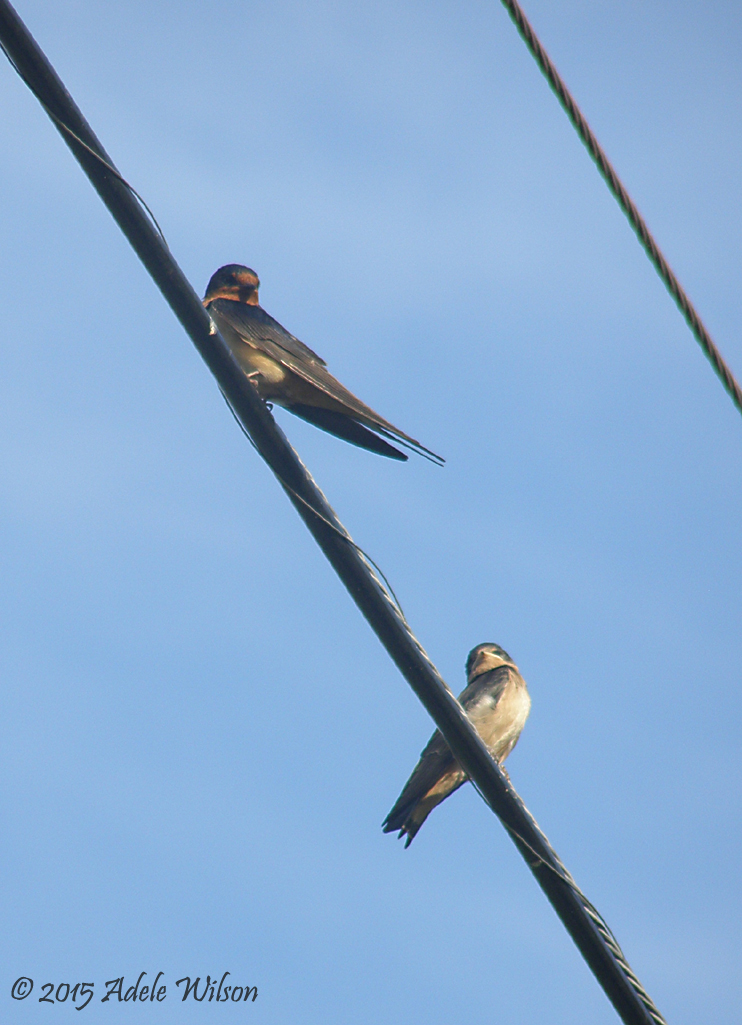 To the right are some juvenile Barn Swallows whom I was able to photograph on June 22nd. Although their wings are already rather long, their tail feathers have not yet grown to the adult length.
 If you have enjoyed these photos, you might want to check out the 117 photos in my book, Bonding with the Barn Swallows.
Many of them show close-ups of the baby Barn Swallows that were hatched
on my porch during 2011 and 2012. There are also photos of the parent
swallows guarding the nest and feeding their young. As an extra bonus,
the book includes photos of five different juvenile Barn Swallows, just
ten days after fledging. You
will be amazed at their varied markings. The book describes how one
special male Barn Swallow communicated to me by his body language on the
utility wire and how, only two days later, I discovered what he was
trying to tell me. The book is available by clicking on the image to the right.
If you have enjoyed these photos, you might want to check out the 117 photos in my book, Bonding with the Barn Swallows.
Many of them show close-ups of the baby Barn Swallows that were hatched
on my porch during 2011 and 2012. There are also photos of the parent
swallows guarding the nest and feeding their young. As an extra bonus,
the book includes photos of five different juvenile Barn Swallows, just
ten days after fledging. You
will be amazed at their varied markings. The book describes how one
special male Barn Swallow communicated to me by his body language on the
utility wire and how, only two days later, I discovered what he was
trying to tell me. The book is available by clicking on the image to the right. 


