Showing posts with label barn swallows. Show all posts

Sunday, August 16, 2015

The Barn Swallows had me fooled!

Text and photos © 2015 Adele Wilson, author of Bonding with the Barn Swallows

This past spring, on April 22nd to be exact, our Barn Swallows returned from their distant wintering quarters in Central and South America.  I saw only five of them that day, and their photo appears below.  I was concerned that there were only five, significantly fewer than during previous years.


I eagerly anticipated the nesting season that was about to commence.  If there were only five Barn Swallows showing up this year, we certainly needed their population number to increase.  As the days went by, however, I was disappointed that I could not find any Barn Swallow nests on this property.  Memories of Barn Swallows nesting on my porch in 2011 and 2012 as described in my book seemed distant and vague.  Besides, who was going to catch all the flying insects this summer?  Many flying insects are regarded as pests by humans, and Barn Swallows have been valued for centuries as natural forms of pest control.

Barn Swallows are adorable birds.  They are amazingly intelligent, agile, and comfortable in the presence of humans, at least in the presence of humans who do not threaten them.  What I like most about Barn Swallows, however, is their relatively egalitarian social structure as compared with many other songbirds.  In the Barn Swallow species, both the male and female build their nest and feed their young.  The male even helps incubate the eggs.  

As the days passed, I began seeing Barn Swallows swooping under the eave of the lower corner of the building where I live.  In fact, the swallows would periodically swoop at me during the mornings when I was in the yard refilling the bird feeders on the nearby tree.

Why were the swallows swooping at me, and what were they trying to protect?  I walked around the building and inspected all of its eaves, searching for Barn Swallow nests.  The photo on the right shows what a typical Barn Swallow nest looks like.  After thoroughly inspecting all four walls of the building, however, I did not find any nests. I then decided to investigate the corner of the building where I had seen the swallows swooping.

I ventured under the eave and carefully inspected the wall and the ceiling of the overhang, but saw no trace of a Barn Swallow nest, or at least the type of cup-shaped nest that Barn Swallows build.  What I did see, however, intrigued me to no end.

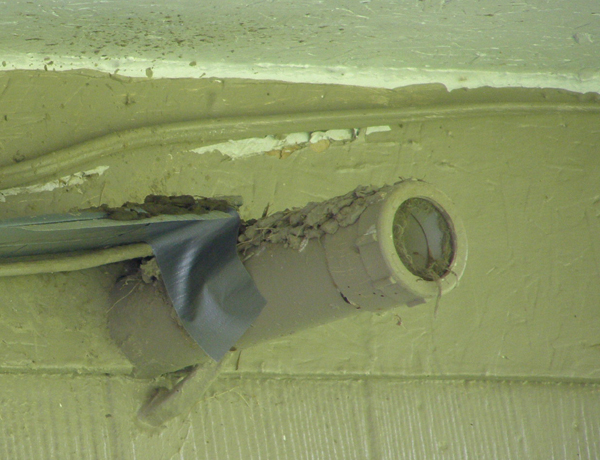
A drainage pipe protrudes from the lower back wall of the building.  I discovered that the top of the pipe, which is at a height of about eight feet (almost 2.5 meters) from the ground, was covered with mud and straw.  The inside pipe perimeter also seemed to be lined with mud and straw, leaving an opening in the center of the pipe.  To the above left is a photo of the pipe that I took on May 10th.

Can Barn Swallows nest inside a pipe?  No, that seemed impossible.  The pipe would have to lead to an open space inside the building where they could build a nest.

Each day I kept wondering if a nest was being built on top of the pipe.  From my second-story porch, I was unable to see the pipe itself, which protrudes from lower level of my building and is obscured by the roof that overhangs it.  

The photo to the right shows the view from my porch as I am looking toward the location of the pipe.  The red arrow points to the location where the pipe is hidden underneath the eave.  Therefore, in order to check the pipe each day, I had to venture down the stairs of my porch and then turn back toward the building.  Once I approached the overhang, I could see the pipe.

A few weeks later, I decided to be a bit more proactive.  Just in case the swallows were in the process of building a nest above the pipe, I fabricated a ledge on which they could build it.  I took a small rectangle of corrugated cardboard and covered it with duct tape.  I then attached the rectangle to the side and above the pipe, again with duct tape.  A little sloppy, but it was the best that I could do!  You can see in the photo at the above left, taken July 17th, that the swallows eventually applied a little mud to the ledge.

Early one morning, I approached the pipe to find out if a nest was being built on top of it.  To my surprise, three birds suddenly came flying out from under the eave and away from the building!  They flew out so quickly that I surmised that they must have been perching on the cardboard ledge I had affixed beside the top of the pipe.

After the three birds flew out and away from the eave, I ventured closer to the pipe.  Upon my inspection of it, I found nothing different … just a pipe covered with mud, the inside of the pipe lined with mud and straw, and a little mud on top of the ledge.

Intermittently over the next few weeks, as I watched from my porch, swallows were flying to and from that corner of the building.  One morning there were two swallows coming and going, each spending only a few seconds under the eave and then departing again.

This made me wonder if the swallows were arriving at the pipe with mud to build a nest on the duct-tape-covered ledge that I had set up.  But no, my checking of the ledge did not reveal any additional mud on top of it.

The swallow activity calmed down for a while, but a few weeks later, I noticed it again.  I began to do some Internet research on whether Barn Swallows ever nest inside a pipe.  The only reference I could find to such an activity was on a website forum where RV and camper owners were complaining that Barn Swallows were starting nests inside the exhaust pipes of their parked vehicles.  The comments indicated that the vehicle owners considered the swallows to be a nuisance.  To rid the swallows and their nests from the pipes, they would start their vehicle engines, causing the exhaust to blow the nesting material away.  Indeed, I found that the diameter of the drainage pipe on my building was approximately the size of the diameter of the exhaust pipe on my car.

On the morning of June 22nd, there had been a whole flock of swallows swooping toward the corner of the building and under the eave.  The swallows seemed to be intent upon raiding the area where the pipe was located.  Through binoculars, I observed that some of the birds seemed to be Cliff Swallows.

It made more sense to me that the pipe would be appropriate for a Cliff Swallow nest rather than a Barn Swallow nest, especially if the pipe led to a wider opening inside the building.  This is because Cliff Swallows build nests with small entrance holes and tunnels leading toward the inside of their nests.  A pipe, if it indeed led to a wider space, would seem to serve that purpose. 

To the right is a photo of a Cliff Swallow nest.  In fact, it is the nest on my porch that was originally built by Barn Swallows but modified by Cliff Swallows two years later.  The entrance hole is part of a passageway that leads to the more open part of the nest. 

Cliff Swallows, who usually nest in colonies, are known to raid their own nests.  In the Cliff Swallow species, there seems to be great competition for nests, supposedly because some Cliff Swallow nests are built so poorly that they end up being destroyed by harsh weather conditions.  Consequently, Cliff Swallows who have built a faulty nest are often forced to usurp the nests of other Cliff Swallows.

Another reason that Cliff Swallows highly value other Cliff Swallow nests is that they have a habit of removing an egg from their own nest and placing it into another nest.  Sometimes they will first remove an egg from the other nest first.  I have read that both the male and female Cliff Swallows engage in this type of activity.

Yet on most mornings, the birds flying around the pipe were Barn Swallows.  And on only one morning was there such a large number of birds flocking toward the corner of the building. 

As the summer progressed, I would sit on my porch each morning.  I continued to see a pair of Barn Swallows, one-by-one, visiting the area of the pipe.  Again, I could not see the pipe itself from my porch because it was obscured by the overhang (see previous photo). 

In the late afternoons and evenings I would again inspect the pipe, but it continued to look the same as it previously had, with no nest visible.  I never actually saw a bird fly in or out of the pipe.  In order to do so, I would have to approach the pipe so closely that it would have given the birds ample warning not enter or leave the pipe.

There were several swallows on the roof of my building on the morning of July 16th, as shown in the photo below, which I took from my porch.  This is the upper roof of the building not shown in the photo, not the lower overhang under which the pipe is located.  Since this upper roof is near the same part of the building where the lower overhang and pipe are located, these birds could have fledged from the nest inside the pipe, assuming, of course, that there was indeed a nest inside the pipe!


The birds on the roof were definitely Barn Swallows, not Cliff Swallows.  One of them is shown in the photo to the right.  Although the breast color looks light, the lack of a white patch on the forehead shows it to be a Barn Swallow.  It is a juvenile, as shown by the continuous breast band.  Unlike European Barn Swallows, our Barn Swallow adults have "broken", or discontinuous breast bands.

On July 17th, while I was sitting on the porch, a male Barn Swallow flew toward the corner of the building, but landed on the nearby fence when he saw me.  I was able to take a photo, which appears below.  The discontinuous breast band, along with the rich colors on the rest of his plumage, shows him to be an adult male.  He didn’t look too happy that I was in his presence!


On the morning of July 18th, there were numerous swallow fledglings on the utility wire.  After observing them closely through binoculars, I noticed that some of them were Cliff Swallows!  The photo below shows a fledgling Cliff Swallow on the left.  The three birds to the Cliff Swallow’s right are fledgling Barn Swallows.


Where did all of these babies hatch?  Had they fledged from a nest on my building?  Or perhaps their parents had directed them to perch on that wire because the wire’s location gives a nice, wide view of our valley, enabling the fledglings to more easily spot their parents flying toward them to feed them.

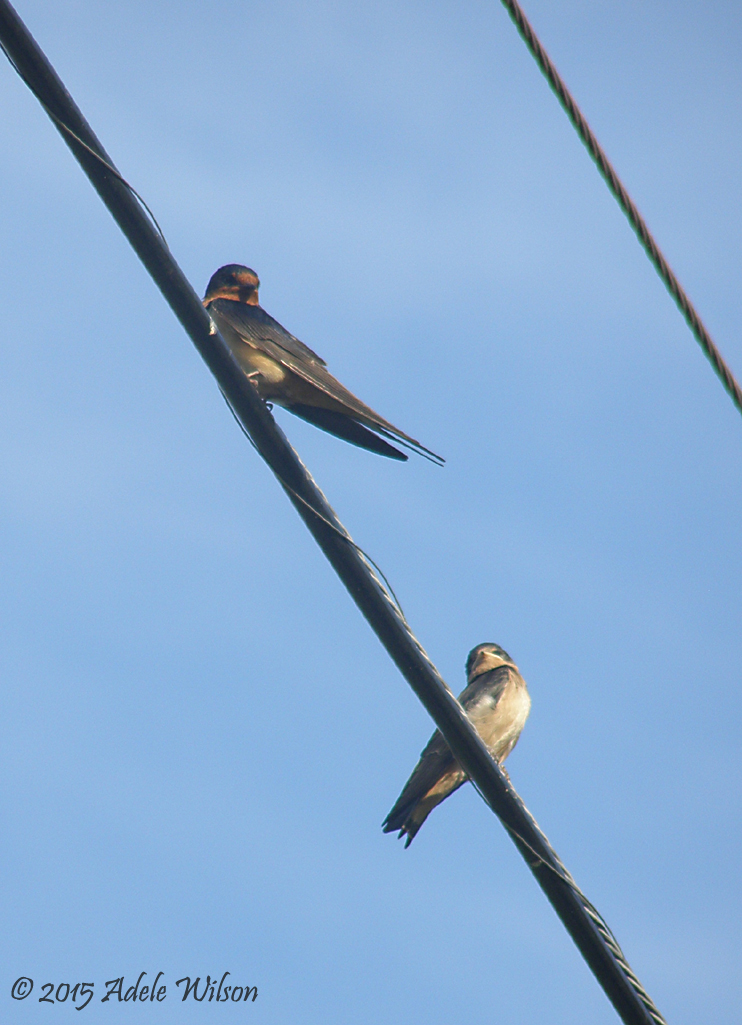
Just eight days later, on July 26th, there were even more swallows on the wire.  Four of them are shown in the photo below.


On August 1st, I was out in my yard refilling the bird feeders on the tree.  A Barn Swallow came flying from the corner of the building and landed on the fence behind the tree.  He allowed me to photograph him, and the photo on the right proves him to have been an adult male.  He could have well have been the same male as in the previous photo taken on July 17th, with the sunlight hitting his feathers differently.


On the morning of August 3rd, I counted 13 swallows on the wires.  There was a group of seven on one wire and a group of six on an adjacent wire.  By observing the birds through binoculars, I surmised that they were all juveniles.  The photo to the left shows two of them.  These are both Barn Swallows.

I began to assume that Barn Swallows had indeed nested in the pipe earlier in the summer.  And perhaps there had been not just one, but two nestings – two broods of swallow babies who had fledged from that nest.

By August 12th, there were no more swallows on the wires.  But, on both the mornings of August 13th and 14th, I observed a solitary swallow circling high over the property.  Although swallows are generally flocking birds, I wondered if this lone swallow had been a male fledgling from the pipe nest who was viewing the nest’s location one more time in order to claim the nest upon his arrival next spring.

Yes, a young male Barn Swallow will sometimes do this.  He will return the following spring and claim the nest in which he was hatched.  He will then proceed to attract a female to the nest, and if the female approves of both him and the nest, the pair will mate, and the female will lay her eggs in that nest.

I experienced this very phenomenon by observing my porch nest during the summers of 2011 and 2012.  It sounds unbelievable that a young Barn Swallow could fly to South America, only to return in the spring and find the very nest in which he was hatched, but this has proven to be true!  You can read a detailed narrative of it in my book.

As of this date, all of our swallows have departed for their long journeys south for the winter.  The photo to the left shows the way the pipe looked on August 16th.  Again, you can see that, although the swallows had applied mud and straw to the top of the ledge that I had installed for them, they had not build a nest there.

It still remains a mystery as to how Barn Swallows could have nested inside the pipe.  Even if I assume that they did so, how did they do it?  I do not own the building and therefore do not know if the pipe leads to an open space.  If the pipe had not been a nesting place for swallows, why else would I have experienced swallows swooping at me while I was walking around the yard near the corner of my building?  And why did we have so many juvenile swallows perching on the nearby utility wire?

Perhaps the mystery will be solved next spring.  I plan to carefully observe whether any of the returning swallows show interest in that corner of the building and the pipe that protrudes from it.


http://www.amazon.com/gp/product/1494481464/ref=as_li_tl?ie=UTF8&camp=1789&creative=390957&creativeASIN=1494481464&linkCode=as2&tag=barnswalfrie-20&linkId=ICHDIZSQRSR4XUPT
In Bonding with the Barn Swallows, you can read about the unexpected location where one special male Barn Swallow perched all night and why he perched there.  You can also read about how that same Barn Swallow communicated to me on two occasions, once through typical Barn Swallow twittering, and again by his body language on the utility wire while perched next to two other Barn Swallows.  Two days later, an event revealed what he was trying to tell me.

Just click on the image to the upper right to find out more about the book.  You can click on "Look inside" to see the Table of Contents and read the first few pages of the book.  Or, you can click on "Surprise me" and read other pages!


Thursday, June 25, 2015

Lady Bluebird is doing fine ...

Text and photos © 2015 Adele Wilson, author of Bonding with the Barn Swallows

As far as I can tell, the new female Bluebird who arrived on the scene on June 12th is doing fine.  I am calling her "Lady Bluebird" because she seems so sophisticated and vigilant.  To the right is a photo that I took of her on the evening of June 14th.

Lady Bluebird is diligently incubating her eggs now.  I sometimes see her in the mornings peeking out of the nest box hole.  The incubation period is critical for female Bluebirds because they like their privacy and do not like being disturbed.  So, when I go out in the yard to refill the bird feeders, I try to tiptoe past her box and pretend that I don't see her inside.

Lady Bluebird's mate (I still call him "Mr. Bluebird"), also seems to be doing fine.  He has been hanging around since May 10th, the date that he and his previous mate took over the first nest box.  Poor little fellow!  He's been through so much, losing his first mate, who ended up abandoning the nest.

Mr. Bluebird seems to be a little more attentive to Lady Bluebird than he was to his previous mate.  He had also been busy guarding his territory, including both his own nest box and the now-empty second box.  He chases House Sparrows from the second box when he sees them, but I don't know if he will succeed in preventing the sparrows from nesting there.

The photo to the left shows Mr. and Lady Bluebird guarding their box on the morning of June 22nd.  Mr. Bluebird is the more brightly colored bird on the left, while Lady Bluebird is on the right.  Mother Nature gives the female Bluebird subtler colors to help guard against their becoming easy prey for cats, racoons, and larger birds.

Just a few minutes before I took this photo, Mr. and Lady Bluebird were guarding the second box.  The photo below shows them around that box.


In the meantime, we now quite a number of swallows flying around -- three different species in all, including Barn Swallows, the birds I wrote about in my book.  The other morning, all three species were flying above the yard.

The few Barn Swallows that arrived in April have now fledged their first broods of the season.  It is easy to recognize the juvenile Barn Swallows flying high in the air because they are slightly smaller than the adults and must flap their wings more rapidly.

To the right are some juvenile Barn Swallows whom I was able to photograph on June 22nd.  Although their wings are already rather long, their tail feathers have not yet grown to the adult length.

Tree Swallows comprise the second species that was present the other morning.  Six Tree Swallows were flying around the second nest box, the box inside which their eggs went missing about a week or so ago.  It was quite a decision for me to remove their nest and clean the box after I discovered their eggs to be gone, but a major factor was that the pair of Tree Swallows were no longer hanging around the box.  To see photos of Tree Swallows, you can go to my post of May 17th.

I thought that removing the nest in the second box would help deter House Sparrows from nesting in the box, but, judging from what I observed this morning, I might be incorrect about that.  I observed a pair of sparrows perching near the box, and the male even went inside the box and came out again.

The third species of swallow that was around the other morning was the Cliff Swallow.  To the left is a rare photo of a Cliff Swallow that I shot in 2014.

The same morning when I spotted the Barn and Tree Swallows flying around, three Cliff Swallows flew up to my porch nest.  House Sparrows are currently using that nest, but the nest is actually a Cliff Swallow nest.  It was a Barn Swallow nest until July 2013, when Cliff Swallows arrived and remodeled it.  The nest was used by Cliff Swallows in both 2013 and 2014.  More about this in a future post.


http://www.amazon.com/gp/product/1494481464/ref=as_li_tl?ie=UTF8&camp=1789&creative=390957&creativeASIN=1494481464&linkCode=as2&tag=barnswalfrie-20&linkId=5WME3VAHNSX3EXHH If you have enjoyed these photos, you might want to check out the 117 photos in my book, Bonding with the Barn Swallows.  Many of them show close-ups of the baby Barn Swallows that were hatched on my porch during 2011 and 2012.  There are also photos of the parent swallows guarding the nest and feeding their young.  As an extra bonus, the book includes photos of five different juvenile Barn Swallows, just ten days after fledging.  You will be amazed at their varied markings.  The book describes how one special male Barn Swallow communicated to me by his body language on the utility wire and how, only two days later, I discovered what he was trying to tell me.  The book is available by clicking on the image to the right. 


Thursday, May 21, 2015

The Hijacking of the Nest Box – Who will win?


Text and photos © 2015 Adele Wilson, author of Bonding with the Barn Swallows

The morning of May 10th began in typical fashion.  The female Tree Swallow was perched on the top of the nest box holding straw in her bill – straw to carry into the box to finish building her nest.

While the female Tree Swallow flew into the nest hole with straw, the male Tree Swallow would guard her from either the top of the box or from the nearby fence post.

I wondered when the female would finish building the nest. She and her mate had claimed the nest box on May 1st, just one week after we had put it up, and she had started building the nest that very day.

The last time I had looked inside the box – on the evening of May 8th – there had been a beautifully woven, circular nest inside. Two dark feathers had been placed at the right front of the nest.

All seemed calm and peaceful that sunny morning of May 10th.  But then, a surprising event occurred.  A pair of Eastern Bluebirds showed up – male and female – and landed on the box!  The Tree Swallows were nowhere in sight.  Perhaps they were flying over the nearby hayfield, catching a late breakfast of flying insects.

Both the male and female Bluebirds immediately began investigating the box.  While one bird perched on the top of the box, the other would peek through its entrance hole.  The photo to the right shows the male on top of the box, with the female on the front.  The hole does not show in the photo, but the female is pointing her bill toward it.  From the photo you can see the brightness of the colors of the male in comparison to the duller colors of the female.

Eventually, the female Bluebird flew from the box, while the male stayed.  All at once, another male Bluebird appeared, and a fight ensued between the two males – right on top of the nest box!

I am not sure which Bluebird won the fight, but soon afterward, the male Tree Swallow returned to the top of the box and started another fight.  This time, two different species were fighting for ownership of the nest box – the Tree Swallow and the newly arriving Bluebird!

As I watched the two males lunge at each other, one bird dropped to the ground, and the other bird followed.  For a few seconds, it looked like the Tree Swallow was on top of the Bluebird, pecking away at him.

The Bluebird then escaped and flew to a nearby tree.  I was hoping that he was not injured and that he had survived the attack.

Later that day, I began second-guessing myself about having seen two male Bluebirds fighting over the box earlier that morning.  Perhaps one of the birds in the skirmish had actually been the male Tree Swallow.  In the right type of sunlight, it might be easy to mistake a male Tree Swallow for a male Bluebird because of the brilliant blue on their backs.

After all, our local Bluebirds are said to begin their first nests of the season around mid March at the earliest. It was now only May 10th and I had not yet seen any baby Bluebirds around here. Would our local male Bluebirds actually be searching for nest sites in early May?

In this region of the US, it is recommended to have Bluebird nest boxes up by mid March in order for the Bluebirds to use them for their first brood of the season. However, we were late mounting our nest box and did not get it up until April 24th. No chance of Bluebirds very soon, I thought! We were consoled with the thought that Bluebirds might use the box for their second brood, perhaps during late June after the Tree Swallows were finished with it.
 
I doubted whether our local Bluebirds, if they had begun their early broods in March or April, would be finished with the stages of egg-laying, egg-incubation, feeding and fledging the nestlings, and continuing to feed the fledglings outside the nest for a couple of weeks thereafter.  The period from the laying of the first egg to the fledging of the young lasts at least 33, but sometimes up to 45, days. Another 12 days would have to be added to that because that is the length of time that baby Bluebirds still need to be fed once they leave the nest.  And it is the male parent Bluebird who often endures the sole burden of feeding the fledglings because the female is sometimes off to build another nest during that time.  Therefore, the length of time that a male is occupied with breeding activities can be from 45 to 57 days, at least a month and a half.  And that does not include the time period of mating that precedes egg-laying.

Well, I suppose it would be possible for the male Bluebirds to have completed their first brood of the season by May 10th.  Or perhaps the males had experienced unsuccessful nesting attempts or found their mates later in the season then usual.  Another possibility is that cold weather had delayed early nesting attempts.

To attempt to solve the mystery, I reviewed my photos from May 10th and found proof that I had indeed seen two male Bluebirds!  Here is a photo I took of a tree in my yard that morning.  It shows two male Eastern Bluebirds on the branches, identified by their bright blue plumage.  (The females display a much duller blue and have brownish heads.)  In the photo, the bird barely visible at the lower right next to the feeder is actually a Blue Jay.


By the time the skirmishes were finished, it was late morning.  A pair of male and female Bluebirds kept returning to the top of the box.  I don’t know whether the male was the one who had been in the fight with the Tree Swallow.  But I do know that, by the time the pair of Bluebirds seemed to have claimed the nest box, I didn’t see either of the pair of Tree Swallows on or around it.

Meanwhile, the male and female Bluebirds continued to investigate the box.  Just as the Tree Swallows had done nine days previously, the Bluebirds, one by one, would test the hole for size and enter the box to examine its contents.  Neither stayed in the box for long.  They were too busy checking out the remainder of the box. The photo on the right shows the female peering inside the hole.

In the Eastern Bluebird species (and in other bird species as well), the female is the one who must approve of the nest site.  The male will first find the nest site and “present” it to her, but she is the one who must give the go-ahead to use the site for nesting.

The female Bluebird therefore seemed to be more thorough in her investigation of the box.  After all, she was the one who would have to approve of it.  Consequently, she diligently inspected the outside of the box as well as the inside.  The photo to the left shows the female examining the back of the box.

But wait! What about the Tree Swallows? They were the ones who had originally found the nest box on May 1st, only a week after we had mounted it. The female had started a nest that very day. She had begun gathering straw and grass in her bill and flying into the nest hole with it.

So which species would be using the nest – the Bluebirds or the Tree Swallows?  I began reading stories of joint nests between the two species, nests in which both Bluebirds and Tree Swallows would lay their eggs and help rear the young.

Time would tell whether Tree Swallows, Bluebirds, or both would be using the nest.  You can find out what eventually occurred by following this blog at the top right of this page. 


http://www.amazon.com/gp/product/1494481464/ref=as_li_tl?ie=UTF8&camp=1789&creative=390957&creativeASIN=1494481464&linkCode=as2&tag=barnswalfrie-20&linkId=5WME3VAHNSX3EXHH
I first began having intimate encounters with wild birds when Barn Swallows nested on my porch during 2011 and 2012.  During those encounters, I became convinced that humans and birds can develop meaningful rapports, communicate with each other, and enjoy mutually beneficial relationships.  You can read about how one special Barn Swallow communicated to me in my book Bonding with the Barn Swallows, available at Amazon at:   http://www.amazon.com/gp/product/1494481464/ref=as_li_tl?ie=UTF8&camp=1789&creative=390957&creativeASIN=1494481464&linkCode=as2&tag=barnswalfrie-20&linkId=5WME3VAHNSX3EXHH

Sunday, May 17, 2015

A Bluebird Nest Box: The Tenants Arrive!

Text and photos © 2015 Adele Wilson

This spring my next-door neighbor kindly put up a Bluebird nest box for me.  After coordinating with our landlord about the location of the box and purchasing the box and the parts to mount it, we finally got it up on April 24th. 

To our pleasant surprise, only one week later, on May 1st, a pair of birds landed on the box and began investigating it!  The two birds took turns poking their heads in and out of the hole to make sure it was the right size.  The photo on the right shows the male investigating the size of the hole.

One by one, the birds entered the nest box and peeked outside through the hole.  One bird would perch on the roof of the box while the other investigated the inside of it.

The photo below shows the male on top of the box with the female inside the box peeking out:


When the birds were satisfied that the box would be suitable for their nest, the female began flying to the nest with straw and carrying it into the box.  The male would guard the box from either its roof or a nearby fence post.

In the photo below, you can see the female on the left side with her feet clutching some straw, and the male guarding from the roof.


But the birds were not Bluebirds.  Instead, they were Tree Swallows!

It was no surprise that Tree Swallows, rather than Bluebirds, decided to use the box.  Although the box was designed for Bluebirds, we did not get it mounted until well after the beginning of the Bluebirds' nesting season, which begins in early to mid March.

However, I was just as delighted with the Tree Swallows as I would have been with Bluebirds.  Tree Swallows are beautiful, too, and an adult Tree Swallow eats about 2,000 flying insects per day.  And the best part was that we only had to have the box up for one week before the Tree Swallows discovered it!

Both male and female Tree Swallows have white breasts and bellies, with dark blue on their backs, wings, tails, and upper heads.  The male is especially beautiful, especially when the sunlight hits his feathers exactly right, showing his lovely iridescent blue!

In the Tree Swallow species, it is the female who builds the nest.  It is the male who has the duty of guarding her and the nest box while she is building it.


The female worked diligently, continuing to bring straw to the box each day.  The male would stand guard duty, either from the top of the box or from the nearby fence post.

Sometimes the female would land on the roof of the box with straw in her beak to rest for a moment before taking it into the nest box.  Sadly, it often took her several attempts to successfully carry the straw into the box.


Below you can see both the male and female on the roof of the box, the male displaying his brilliant, bright blue plumage and the female holding a few strands of straw in her bill.


I began to wonder what the inside of the box looked like.  Was it a hodge-podge of straw and grass, or was it a neatly woven nest?

Around 6 p.m. on May 8th, my neighbor told me she had not seen the Tree Swallows guarding the box that afternoon.  My curiosity then got the best of me, and I could no longer resist looking inside the box.  About half an hour later, with the birds nowhere in sight, I ventured to the box, carefully opened the door, and looked inside.

What I saw was quite an amazement to behold!  Strands of straw were woven into a cup shape, even with a couple of dark feathers in the front.  You can see the strand of straw protruding on the left side of the nest, indicating that the nest was still a work in progress.


Just 30 minutes later, I sighted the female Tree Swallow on the wire above my driveway.  She continued to perch there, softly twittering the whole time, and even let me take quite a few pictures of her.

All seemed peaceful, with everything going as it should.  Little did I know that a surprise was to ensue just two days later.   And that surprise was not to involve eggs or babies.  Follow this blog to find out what the surprise was! 


http://www.amazon.com/gp/product/1494481464/ref=as_li_tl?ie=UTF8&camp=1789&creative=390957&creativeASIN=1494481464&linkCode=as2&tag=barnswalfrie-20&linkId=5WME3VAHNSX3EXHH
I first began having intimate encounters with wild birds when Barn Swallows nested on my porch during 2011 and 2012.  During those encounters, I became convinced that humans and birds can develop meaningful rapports, communicate with each other, and enjoy mutually beneficial relationships.  You can read about how one special Barn Swallow communicated to me in my book Bonding with the Barn Swallows, available at Amazon at:   http://www.amazon.com/gp/product/1494481464/ref=as_li_tl?ie=UTF8&camp=1789&creative=390957&creativeASIN=1494481464&linkCode=as2&tag=barnswalfrie-20&linkId=5WME3VAHNSX3EXHH


Sunday, March 8, 2015

Winter Woodpeckers and What is a First-Year Bird?

Text and photos © 2015 Adele Wilson


Pileated Woodpecker
January 12th was quite a day for me, woodpecker-wise!  Early that morning, for the very first time, a Pileated Woodpecker came to visit one of the feeders on the tree by my driveway.  I had occasionally seen Pileated Woodpeckers around here before, but not in my back yard.  It was a cold and frosty morning, but I managed to get a few shots, like this one.  The physical positions that these woodpeckers are able to assume while eating from feeders are amazing!

Early in the morning of January 17th, I again saw the Pileated Woodpecker as I was leaving home to run some errands.  By the time I arrived back home, it was around noon and the sun was shining brightly.  As I was ascending my porch stairs, I looked over to the tree by the driveway where I had seen the Pileated Woodpecker that morning. There was a Black-Capped Chickadee eating from the feeder.

Red-Bellied Woodpecker
Soon the Chickadee left, and a Red-Bellied Woodpecker showed up!  You can see him in the picture on the left.  He was obviously a male because of the bright patch of red on the top of his head extending down the back of his neck.

Red-Bellied Woodpeckers do have slightly red bellies, although this woodpecker's red belly does not show in the photo above.  However, if you look very carefully at the photo below (from February 22nd), you may be able to see a light red belly.

Red-Bellied Woodpecker showing his red belly

Downy Woodpecker
After the Red-Bellied Woodpecker finished eating, he hitched up the tree and flew away.  Then yet another type of woodpecker appeared!  This time it was a Downy Woodpecker, as shown in the photo on the left.  The lack of a red patch on the back of its head shows this bird to be a female.

The Downy ate for a few minutes, at which point a Carolina Wren appeared and chased it from the feeder!  In the photo below, the flying bird on the left is the Downy Woodpecker, and you can see the Wren on the feeder on the right.

Carolina Wren having scared Downy Woodpecker from feeder!

Pileated Woodpecker
Since that day, the female Pileated Woodpecker has visited my feeders quite a number of times, often around 8 o’clock in the morning.  On the left is a photo I took of her on the morning of January 24th when we had snow on the ground.  If she looks like Woody Woodpecker, you're not imagining it.  Indeed, the appearance of the Woody Woodpecker cartoon character was derived from the Pileated Woodpecker!  (Thanks to Mary Huebner for this information.)


It turns out that this Pileated Woodpecker is a female.  If she were a male, she would have a red stripe on the lower part of her face instead of a black one.  Ornithologists sometimes call this stripe a “moustache”.


I kept wondering if this female woodpecker had a mate because she is the only Pileated Woodpecker I have seen in my back yard this winter.  I have seen no males, only her.  Last fall I spotted a pair of these woodpeckers on the neighbor’s tree across the road.  This has made me wonder if the Pileated Woodpecker I have been observing in my back yard this winter is the female of that pair.  If so, the question would arise, where is her mate?

Pileated Woodpecker
The photo on the right, taken February 5th on the tree by my driveway, shows how Pileated Woodpeckers move up and down trees.  The Pileated is North America's largest woodpecker, with its length measuring from 16 to 19.5 inches (40 to 49 cm).   There was a North American Woodpecker known to be larger, and that was the Ivory-Billed Woodpecker of the southeastern US.  Sadly, the Ivory-Billed Woodpecker, which looked much like the Pileated, is now thought to be extinct.

The Pileated Woodpecker generally makes its home in forests and is extremely shy toward humans.  The National Audubon Society Field Guide to North American Birds, Eastern Region, states that seeing this species up close "usually requires careful stalking."  Reading this made me realize how fortunate I am to have this bird visit my feeders this winter!

To get these pictures, I had to hide behind the wall of my porch.  As long as this shy woodpecker did not know I was there, I was able to snap some photos.  However, as soon as I would move to a different location on the porch, the woodpecker would see me and take flight.

Pileated Woodpecker, female, black stripe on lower part of face
Above is a photo I shot on February 7th.   In this photo you can clearly see the black, horizontal stripe that extends from the beginning of the bill along the side of the face.  As mentioned above, this indicates the woodpecker's gender to be female.  On the male, this stripe is red.

I continued wondering if this female had a mate, and if so, where he was.  I eventually developed a hypothesis, based on a link to photos that my Facebook friend, Nathan Elderkin (thank you, Nathan!), shared with me.  The photos showed baby Pileated Woodpeckers in a nest being fed by their parents.  Surprisingly, the genders of the babies were already apparent!  The males had the red facial stripes, while the corresponding stripes on the females were black.  If you wish to see the photos, you can click here.

Baby Pileated Woodpeckers stay in their nest for a month after they are hatched.  Unlike many other baby birds that do not reveal their genders until after their first molt, baby Pileated Woodpeckers apparently show their genders by their initial plumage.

With this new information about how quickly juvenile Pileated Woodpeckers grow up to look like adults, my hypothesis is that the female Pileated Woodpecker visiting my feeders might be a juvenile.  (If anyone has a different opinion on this, I would welcome your comment below because I am still learning!)

“Juvenile” is one way to describe a bird that was hatched the previous summer.  Another term applied to birds of this age is “first-year”.   A first-year bird is a bird of less than twelve months of age.  Often during winter or spring, a first-year bird can look much like a full adult.  The main difference is that they have yet to experience a mating season or raise a family of their own.  Therefore, despite the fact that the female Pileated Woodpecker looks like a full adult, she could be a first-year bird who has not yet found a mate.

Some birds, like Barn Swallows for instance, retain part of their juvenile plumage until they are nearly a year old.  When North American Barn Swallows arrive in the US during the spring from their southerly wintering grounds, the first-year swallows can generally be identified by their breast bands, which tend to be continuous rather than discontinuous.  All North American Barn Swallow adults display a discontinuous, or "broken", breast band, meaning that the breast band is generally visible on the sides of the body only.  Sometimes, particularly on the males, there is also a dark patch in the center of the breast, which would be part of the breast band if it were continuous. 

When I first began studying Barn Swallows, I was confused by some of the photos on the Internet, which showed adult Barn Swallows with thick, dark, breast bands.  These Barn Swallows did not look like ours here in the US!  I eventually learned that these photos were of Eurasian Barn Swallows, which always display continuous breast bands, whether they are juveniles or adults.  There is much more about the “breast band phenomenon” in my book, Bonding with the Barn Swallows.

So the mystery continues.  Is the female Pileated Woodpecker who is visiting my feeders this winter a full adult?  And, if so, where is her mate, or did something happen to him?  Or, is this female still a juvenile, a first-year bird that was hatched last summer?  If so, I expect that she will find a mate this spring.


http://www.amazon.com/gp/product/1494481464/ref=as_li_tl?ie=UTF8&camp=1789&creative=390957&creativeASIN=1494481464&linkCode=as2&tag=barnswalfrie-20&linkId=6563CMOIKLNRCK2H
I first began having intimate encounters with wild birds when Barn Swallows nested on my porch during 2011 and 2012.  During those encounters, I became convinced that humans and birds can develop meaningful rapports, communicate with each other, and enjoy mutually beneficial relationships.  You can read about my experiences in my book Bonding with the Barn Swallows, available at Amazon at:  http://www.amazon.com/gp/product/1494481464/ref=as_li_tl?ie=UTF8&camp=1789&creative=390957&creativeASIN=1494481464&linkCode=as2&tag=barnswalfrie-20&linkId=6563CMOIKLNRCK2H

Prices on Amazon fluctuate greatly.  Last week the price of the book was over $35.00, but as of today, March 8, 2015, the price is only $24.20.  I cannot predict when the price will go up again; so if you are interested in purchasing the book, today would be the optimal time!  Just click on the image above to read a preview, and if you would like to purchase it, just click "Add to Cart" on the right side of your screen.