Showing posts with label nesting. Show all posts

Thursday, June 25, 2015

Lady Bluebird is doing fine ...

Text and photos © 2015 Adele Wilson, author of Bonding with the Barn Swallows

As far as I can tell, the new female Bluebird who arrived on the scene on June 12th is doing fine.  I am calling her "Lady Bluebird" because she seems so sophisticated and vigilant.  To the right is a photo that I took of her on the evening of June 14th.

Lady Bluebird is diligently incubating her eggs now.  I sometimes see her in the mornings peeking out of the nest box hole.  The incubation period is critical for female Bluebirds because they like their privacy and do not like being disturbed.  So, when I go out in the yard to refill the bird feeders, I try to tiptoe past her box and pretend that I don't see her inside.

Lady Bluebird's mate (I still call him "Mr. Bluebird"), also seems to be doing fine.  He has been hanging around since May 10th, the date that he and his previous mate took over the first nest box.  Poor little fellow!  He's been through so much, losing his first mate, who ended up abandoning the nest.

Mr. Bluebird seems to be a little more attentive to Lady Bluebird than he was to his previous mate.  He had also been busy guarding his territory, including both his own nest box and the now-empty second box.  He chases House Sparrows from the second box when he sees them, but I don't know if he will succeed in preventing the sparrows from nesting there.

The photo to the left shows Mr. and Lady Bluebird guarding their box on the morning of June 22nd.  Mr. Bluebird is the more brightly colored bird on the left, while Lady Bluebird is on the right.  Mother Nature gives the female Bluebird subtler colors to help guard against their becoming easy prey for cats, racoons, and larger birds.

Just a few minutes before I took this photo, Mr. and Lady Bluebird were guarding the second box.  The photo below shows them around that box.


In the meantime, we now quite a number of swallows flying around -- three different species in all, including Barn Swallows, the birds I wrote about in my book.  The other morning, all three species were flying above the yard.

The few Barn Swallows that arrived in April have now fledged their first broods of the season.  It is easy to recognize the juvenile Barn Swallows flying high in the air because they are slightly smaller than the adults and must flap their wings more rapidly.

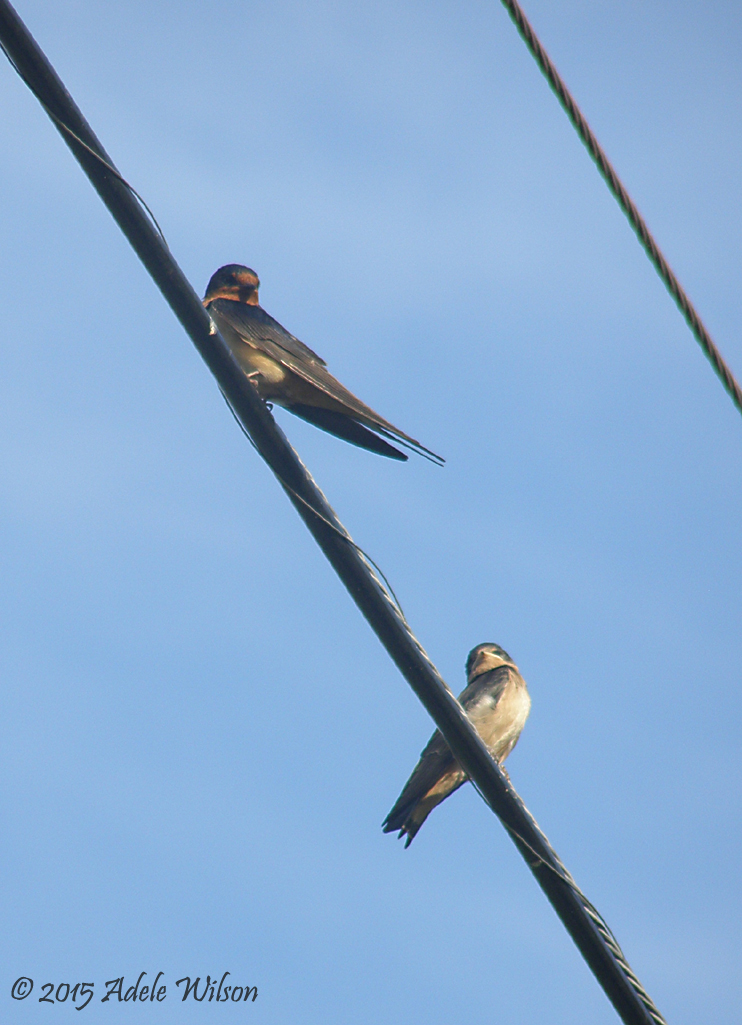
To the right are some juvenile Barn Swallows whom I was able to photograph on June 22nd.  Although their wings are already rather long, their tail feathers have not yet grown to the adult length.

Tree Swallows comprise the second species that was present the other morning.  Six Tree Swallows were flying around the second nest box, the box inside which their eggs went missing about a week or so ago.  It was quite a decision for me to remove their nest and clean the box after I discovered their eggs to be gone, but a major factor was that the pair of Tree Swallows were no longer hanging around the box.  To see photos of Tree Swallows, you can go to my post of May 17th.

I thought that removing the nest in the second box would help deter House Sparrows from nesting in the box, but, judging from what I observed this morning, I might be incorrect about that.  I observed a pair of sparrows perching near the box, and the male even went inside the box and came out again.

The third species of swallow that was around the other morning was the Cliff Swallow.  To the left is a rare photo of a Cliff Swallow that I shot in 2014.

The same morning when I spotted the Barn and Tree Swallows flying around, three Cliff Swallows flew up to my porch nest.  House Sparrows are currently using that nest, but the nest is actually a Cliff Swallow nest.  It was a Barn Swallow nest until July 2013, when Cliff Swallows arrived and remodeled it.  The nest was used by Cliff Swallows in both 2013 and 2014.  More about this in a future post.


http://www.amazon.com/gp/product/1494481464/ref=as_li_tl?ie=UTF8&camp=1789&creative=390957&creativeASIN=1494481464&linkCode=as2&tag=barnswalfrie-20&linkId=5WME3VAHNSX3EXHH If you have enjoyed these photos, you might want to check out the 117 photos in my book, Bonding with the Barn Swallows.  Many of them show close-ups of the baby Barn Swallows that were hatched on my porch during 2011 and 2012.  There are also photos of the parent swallows guarding the nest and feeding their young.  As an extra bonus, the book includes photos of five different juvenile Barn Swallows, just ten days after fledging.  You will be amazed at their varied markings.  The book describes how one special male Barn Swallow communicated to me by his body language on the utility wire and how, only two days later, I discovered what he was trying to tell me.  The book is available by clicking on the image to the right. 


Monday, June 15, 2015

Second Time Around – A New Beginning

Text and photos © 2015 Adele Wilson, author of Bonding with the Barn Swallows

Mr. Bluebird has found a new mate!  His previous mate laid five eggs in May and then abandoned the nest box without incubating the eggs.  Needless to say, the eggs did not hatch.

We still do not know why Mr. Bluebird’s previous mate disappeared.  I did not remove the unhatched eggs from the nest; Mr. Bluebird told me not to do so!  Every evening I would see him hanging around the nest box as if to be protecting his eggs.  Such a sad sight!

But on Friday morning, June 12th, a seeming miracle occurred.  A new female Bluebird appeared and began perching on top of the nest box with Mr. Bluebird!

Mr. Bluebird commenced the courtship ritual of holding some straw in his bill to show Ms. Bluebird that it was time to build the nest.

Under normal circumstances, a male Bluebird will gather the first nesting material and bring it to the box.  This time, however, since there was already straw in the box from the nest that had been built by his previous mate, Mr. Bluebird just ventured inside the box, grabbed some straw, and then brought it to the top of the box!

The photo at the above right shows Mr. Bluebird on top of the nest box with straw in his bill.  If you look carefully at the end of his tail, you will see the new Ms. Bluebird perching in the background on the fence.

Ms. Bluebird apparently received Mr. Bluebird's message that it was time to start building a nest because Ms. Bluebird began bringing straw to the box.

The photo on the left shows Ms. Bluebird flying to the box with straw in her bill while Mr. Bluebird guards the box from its top.  Presumably, Ms. Bluebird is building a new nest on top of the old one – the one that the former Ms. Bluebird built in May.

I've read that Bluebirds sometimes do this; that is, they build a nest directly on top of an old one.  To be more accurate, the FEMALE Bluebird builds a nest on top of the old one.  That is because, in this species, the female is the nest builder while the male's job is to stand guard.

As an example of Bluebirds building a nest on top of an existing nest, the Bluebirds that arrived at this box on May 10th – nine days after a pair of Tree Swallows had built their nest inside the box – chased the Tree Swallows away and began building their own nest on top of the Tree Swallows' nest.  The nest builder at that time was the former Ms. Bluebird.  She finished building the nest, and, as previously mentioned, laid five eggs.

But now that the former Ms. Bluebird has vanished and Mr. Bluebird has found a new mate, the process begins all over again!  

On Friday morning, June 12th, even after the new Ms. Bluebird began carrying the straw inside the box, Mr. Bluebird would continue to appear at the box with straw in his bill.  The photo on the right shows Mr. Bluebird holding straw while peeking out of the box’s hole while Ms. Bluebird is also holding some straw at the top of the box.

It seems that, this time, Mr. Bluebird is being extra diligent and proactive to ensure that the new Ms. Bluebird remains around the nesting site.  I have seen Mr. Bluebird on the front of the nest box (see photo below) engaging in the motions of feeding Ms. Bluebird through the hole even when he knows she is not inside the box!

I suppose that Mr. Bluebird is practicing for the time when Ms. Bluebird lays her eggs and begins to incubate them.  That’s the time when, in the Eastern Bluebird species, the male must begin bringing food to the nest and feeding the female, just as if he is feeding a baby Bluebird.

I am no expert on Bluebird behavior, but it seemed to me that Mr. Bluebird did not feed the former Ms. Bluebird often enough after she had laid her eggs.  Sometimes Mr. Bluebird would come to the box, feed her through the hole, and take flight, after which the former Ms. Bluebird would immediately fly out of the box after him!

I am praying that this nesting attempt will be successful.  Our weather pattern has stabilized now.  Each day is warm and humid, often with rain showers in the afternoon or evening.  During the time when the former Ms. Bluebird was laying her eggs, we were in the middle of a cool spell, and one night we even had frost.  Perhaps, as my neighbor suggested to me, the former Ms. Bluebird became confused and thought that winter was coming, making it too cold to raise chicks. 

Stay tuned to find out what becomes of Mr. Bluebird’s new relationship!  The next post will show photos of both the previous Ms. Bluebird and the current Ms. Bluebird.  You can follow this blog by entering your email address at the top right of this page.


http://www.amazon.com/gp/product/1494481464/ref=as_li_tl?ie=UTF8&camp=1789&creative=390957&creativeASIN=1494481464&linkCode=as2&tag=barnswalfrie-20&linkId=IZIYNBUNQPAJOXYO
I first began having intimate encounters with wild birds when Barn Swallows nested on my porch during 2011 and 2012.  During those encounters, I became convinced that humans and birds can develop meaningful rapports, communicate with each other, and enjoy mutually beneficial relationships.  You can read about how one special Barn Swallow communicated to me in my book Bonding with the Barn Swallows, available at Amazon.  To find out more about the book and read a preview, just click on the image to the right.   


Thursday, May 21, 2015

The Hijacking of the Nest Box – Who will win?


Text and photos © 2015 Adele Wilson, author of Bonding with the Barn Swallows

The morning of May 10th began in typical fashion.  The female Tree Swallow was perched on the top of the nest box holding straw in her bill – straw to carry into the box to finish building her nest.

While the female Tree Swallow flew into the nest hole with straw, the male Tree Swallow would guard her from either the top of the box or from the nearby fence post.

I wondered when the female would finish building the nest. She and her mate had claimed the nest box on May 1st, just one week after we had put it up, and she had started building the nest that very day.

The last time I had looked inside the box – on the evening of May 8th – there had been a beautifully woven, circular nest inside. Two dark feathers had been placed at the right front of the nest.

All seemed calm and peaceful that sunny morning of May 10th.  But then, a surprising event occurred.  A pair of Eastern Bluebirds showed up – male and female – and landed on the box!  The Tree Swallows were nowhere in sight.  Perhaps they were flying over the nearby hayfield, catching a late breakfast of flying insects.

Both the male and female Bluebirds immediately began investigating the box.  While one bird perched on the top of the box, the other would peek through its entrance hole.  The photo to the right shows the male on top of the box, with the female on the front.  The hole does not show in the photo, but the female is pointing her bill toward it.  From the photo you can see the brightness of the colors of the male in comparison to the duller colors of the female.

Eventually, the female Bluebird flew from the box, while the male stayed.  All at once, another male Bluebird appeared, and a fight ensued between the two males – right on top of the nest box!

I am not sure which Bluebird won the fight, but soon afterward, the male Tree Swallow returned to the top of the box and started another fight.  This time, two different species were fighting for ownership of the nest box – the Tree Swallow and the newly arriving Bluebird!

As I watched the two males lunge at each other, one bird dropped to the ground, and the other bird followed.  For a few seconds, it looked like the Tree Swallow was on top of the Bluebird, pecking away at him.

The Bluebird then escaped and flew to a nearby tree.  I was hoping that he was not injured and that he had survived the attack.

Later that day, I began second-guessing myself about having seen two male Bluebirds fighting over the box earlier that morning.  Perhaps one of the birds in the skirmish had actually been the male Tree Swallow.  In the right type of sunlight, it might be easy to mistake a male Tree Swallow for a male Bluebird because of the brilliant blue on their backs.

After all, our local Bluebirds are said to begin their first nests of the season around mid March at the earliest. It was now only May 10th and I had not yet seen any baby Bluebirds around here. Would our local male Bluebirds actually be searching for nest sites in early May?

In this region of the US, it is recommended to have Bluebird nest boxes up by mid March in order for the Bluebirds to use them for their first brood of the season. However, we were late mounting our nest box and did not get it up until April 24th. No chance of Bluebirds very soon, I thought! We were consoled with the thought that Bluebirds might use the box for their second brood, perhaps during late June after the Tree Swallows were finished with it.
 
I doubted whether our local Bluebirds, if they had begun their early broods in March or April, would be finished with the stages of egg-laying, egg-incubation, feeding and fledging the nestlings, and continuing to feed the fledglings outside the nest for a couple of weeks thereafter.  The period from the laying of the first egg to the fledging of the young lasts at least 33, but sometimes up to 45, days. Another 12 days would have to be added to that because that is the length of time that baby Bluebirds still need to be fed once they leave the nest.  And it is the male parent Bluebird who often endures the sole burden of feeding the fledglings because the female is sometimes off to build another nest during that time.  Therefore, the length of time that a male is occupied with breeding activities can be from 45 to 57 days, at least a month and a half.  And that does not include the time period of mating that precedes egg-laying.

Well, I suppose it would be possible for the male Bluebirds to have completed their first brood of the season by May 10th.  Or perhaps the males had experienced unsuccessful nesting attempts or found their mates later in the season then usual.  Another possibility is that cold weather had delayed early nesting attempts.

To attempt to solve the mystery, I reviewed my photos from May 10th and found proof that I had indeed seen two male Bluebirds!  Here is a photo I took of a tree in my yard that morning.  It shows two male Eastern Bluebirds on the branches, identified by their bright blue plumage.  (The females display a much duller blue and have brownish heads.)  In the photo, the bird barely visible at the lower right next to the feeder is actually a Blue Jay.


By the time the skirmishes were finished, it was late morning.  A pair of male and female Bluebirds kept returning to the top of the box.  I don’t know whether the male was the one who had been in the fight with the Tree Swallow.  But I do know that, by the time the pair of Bluebirds seemed to have claimed the nest box, I didn’t see either of the pair of Tree Swallows on or around it.

Meanwhile, the male and female Bluebirds continued to investigate the box.  Just as the Tree Swallows had done nine days previously, the Bluebirds, one by one, would test the hole for size and enter the box to examine its contents.  Neither stayed in the box for long.  They were too busy checking out the remainder of the box. The photo on the right shows the female peering inside the hole.

In the Eastern Bluebird species (and in other bird species as well), the female is the one who must approve of the nest site.  The male will first find the nest site and “present” it to her, but she is the one who must give the go-ahead to use the site for nesting.

The female Bluebird therefore seemed to be more thorough in her investigation of the box.  After all, she was the one who would have to approve of it.  Consequently, she diligently inspected the outside of the box as well as the inside.  The photo to the left shows the female examining the back of the box.

But wait! What about the Tree Swallows? They were the ones who had originally found the nest box on May 1st, only a week after we had mounted it. The female had started a nest that very day. She had begun gathering straw and grass in her bill and flying into the nest hole with it.

So which species would be using the nest – the Bluebirds or the Tree Swallows?  I began reading stories of joint nests between the two species, nests in which both Bluebirds and Tree Swallows would lay their eggs and help rear the young.

Time would tell whether Tree Swallows, Bluebirds, or both would be using the nest.  You can find out what eventually occurred by following this blog at the top right of this page. 


http://www.amazon.com/gp/product/1494481464/ref=as_li_tl?ie=UTF8&camp=1789&creative=390957&creativeASIN=1494481464&linkCode=as2&tag=barnswalfrie-20&linkId=5WME3VAHNSX3EXHH
I first began having intimate encounters with wild birds when Barn Swallows nested on my porch during 2011 and 2012.  During those encounters, I became convinced that humans and birds can develop meaningful rapports, communicate with each other, and enjoy mutually beneficial relationships.  You can read about how one special Barn Swallow communicated to me in my book Bonding with the Barn Swallows, available at Amazon at:   http://www.amazon.com/gp/product/1494481464/ref=as_li_tl?ie=UTF8&camp=1789&creative=390957&creativeASIN=1494481464&linkCode=as2&tag=barnswalfrie-20&linkId=5WME3VAHNSX3EXHH

Sunday, May 17, 2015

A Bluebird Nest Box: The Tenants Arrive!

Text and photos © 2015 Adele Wilson

This spring my next-door neighbor kindly put up a Bluebird nest box for me.  After coordinating with our landlord about the location of the box and purchasing the box and the parts to mount it, we finally got it up on April 24th. 

To our pleasant surprise, only one week later, on May 1st, a pair of birds landed on the box and began investigating it!  The two birds took turns poking their heads in and out of the hole to make sure it was the right size.  The photo on the right shows the male investigating the size of the hole.

One by one, the birds entered the nest box and peeked outside through the hole.  One bird would perch on the roof of the box while the other investigated the inside of it.

The photo below shows the male on top of the box with the female inside the box peeking out:


When the birds were satisfied that the box would be suitable for their nest, the female began flying to the nest with straw and carrying it into the box.  The male would guard the box from either its roof or a nearby fence post.

In the photo below, you can see the female on the left side with her feet clutching some straw, and the male guarding from the roof.


But the birds were not Bluebirds.  Instead, they were Tree Swallows!

It was no surprise that Tree Swallows, rather than Bluebirds, decided to use the box.  Although the box was designed for Bluebirds, we did not get it mounted until well after the beginning of the Bluebirds' nesting season, which begins in early to mid March.

However, I was just as delighted with the Tree Swallows as I would have been with Bluebirds.  Tree Swallows are beautiful, too, and an adult Tree Swallow eats about 2,000 flying insects per day.  And the best part was that we only had to have the box up for one week before the Tree Swallows discovered it!

Both male and female Tree Swallows have white breasts and bellies, with dark blue on their backs, wings, tails, and upper heads.  The male is especially beautiful, especially when the sunlight hits his feathers exactly right, showing his lovely iridescent blue!

In the Tree Swallow species, it is the female who builds the nest.  It is the male who has the duty of guarding her and the nest box while she is building it.


The female worked diligently, continuing to bring straw to the box each day.  The male would stand guard duty, either from the top of the box or from the nearby fence post.

Sometimes the female would land on the roof of the box with straw in her beak to rest for a moment before taking it into the nest box.  Sadly, it often took her several attempts to successfully carry the straw into the box.


Below you can see both the male and female on the roof of the box, the male displaying his brilliant, bright blue plumage and the female holding a few strands of straw in her bill.


I began to wonder what the inside of the box looked like.  Was it a hodge-podge of straw and grass, or was it a neatly woven nest?

Around 6 p.m. on May 8th, my neighbor told me she had not seen the Tree Swallows guarding the box that afternoon.  My curiosity then got the best of me, and I could no longer resist looking inside the box.  About half an hour later, with the birds nowhere in sight, I ventured to the box, carefully opened the door, and looked inside.

What I saw was quite an amazement to behold!  Strands of straw were woven into a cup shape, even with a couple of dark feathers in the front.  You can see the strand of straw protruding on the left side of the nest, indicating that the nest was still a work in progress.


Just 30 minutes later, I sighted the female Tree Swallow on the wire above my driveway.  She continued to perch there, softly twittering the whole time, and even let me take quite a few pictures of her.

All seemed peaceful, with everything going as it should.  Little did I know that a surprise was to ensue just two days later.   And that surprise was not to involve eggs or babies.  Follow this blog to find out what the surprise was! 


http://www.amazon.com/gp/product/1494481464/ref=as_li_tl?ie=UTF8&camp=1789&creative=390957&creativeASIN=1494481464&linkCode=as2&tag=barnswalfrie-20&linkId=5WME3VAHNSX3EXHH
I first began having intimate encounters with wild birds when Barn Swallows nested on my porch during 2011 and 2012.  During those encounters, I became convinced that humans and birds can develop meaningful rapports, communicate with each other, and enjoy mutually beneficial relationships.  You can read about how one special Barn Swallow communicated to me in my book Bonding with the Barn Swallows, available at Amazon at:   http://www.amazon.com/gp/product/1494481464/ref=as_li_tl?ie=UTF8&camp=1789&creative=390957&creativeASIN=1494481464&linkCode=as2&tag=barnswalfrie-20&linkId=5WME3VAHNSX3EXHH


Sunday, December 14, 2014

How Baby Barn Swallows Grow Up (includes photos)


by Adele Barger Wilson, author of Bonding with the Barn Swallows
Photos and text © 2014 Adele Wilson

Bonding with the Barn Swallows consists of 186 pages and includes 117 photos.  The book is available from Amazon at:


In eastern West Virginia, Barn Swallows return from South America around mid-April.  After recuperating from their long journey north by resting and feasting on flying insects, the swallows begin their courtship activities.

Once the female chooses a mate, her mate will show her either a previously used nest or a new nesting site.  If the female approves of the location, the pair will begin to either refurbish the old nest or, if no old nest is available, to build a nest from scratch.

Once the nest is ready, the pair of swallows begin lining it with feathers.  The feathers ensure both warmth and cushioning for the soon-to-be-laid eggs.

A female Barn Swallow generally lays three to six eggs, with the average number being five.  She begins incubating her eggs on the day before the last egg is laid and continues incubating them for about thirteen to fifteen days.

During the incubation time period, the female sits on the nest all night.  The male will guard her by perching near the nest in order to prevent her from mating with other males.

The male will take turns sitting on the eggs during the daytime so that the female can forage for flying insects.  The female will return to the nest when she has had her fill, allowing the male to leave the nest and do the same.  Just before sunset, the female will settle into the nest for the night.

The eggs hatch over a period of one to three days.  The hatchlings are tiny, pink, and featherless.  The female must continue sitting on the nest for the first few days in order to keep the hatchlings warm.  She will take only short breaks outside the nest to capture insects on the fly.  Both the female and the male feed the chicks by bringing insects to the nest.

The babies will not be large enough to show their heads above the nest for a few days.  In fact their eyes are still closed during the first week of their lives. 

As the babies grow larger, so does the job of feeding them.   Feeding the babies is an arduous task that begins just after sunrise and lasts until sunset.

Barn Swallows are very devoted parents. The papa Barn Swallow shares the duty of feeding the nestlings.  It is not unusual for the parent swallows, one at a time, to arrive at the nest with food every few minutes.

The babies are able to start flapping their wings on their ninth day of life.  From about day twelve they are able to preen themselves.  While their feathers are still growing, the babies display a rather ragged appearance.

By the time a chick is sixteen to seventeen days old, it has acquired much of its juvenile plumage.  Chicks can fledge (leave the nest) at the age of eighteen days or wait as long as twenty-three days.  Nineteen days is the average fledging age that I have observed.

In the cases of some broods, all of the chicks leave the nest on the same day, while in other cases, part of the brood will fledge on one day, with the other part waiting until the next day.  Often a fledgling will return to the nest on the night of the day that it has fledged.  It will spend the night, and then leave the nest for good the following day.

The photo on the right was taken the night before the day that all five of the chicks fledged from the nest.  I came home from work that evening to find the nest totally bare.

But later that evening, there was a great surprise.  Two of the fledglings returned to the nest and spent the night!  Early the next morning, however, the two fledglings left the nest for good.  As I was leaving for work that morning, I spotted all five of the fledglings on a fence in a nearby horse pasture, awaiting feeding by their parents.

It has been said that the parents will spend a week feeding the fledglings outside the nest, but sometimes this time period can be extended.  To the left is a photo of a juvenile, about ten days after leaving the nest.  My estimate of its age is about 29 days.

In Bonding with the Barn Swallows, I share my personal experiences with three broods of Barn Swallows on my porch through text and photos.  The book describes the wonders of seeing them guard the nest area from the utility wire, the male guarding his mate (from quite unusual positions on the porch!), marking the nest with a feather, incubating the eggs, feeding the babies, and even taking breaks to land on the porch rail to let me photograph them! 

Included is the story about how one special male Barn Swallow and I became friends.  He even communicated to me twice, once vocally and the other through his body language.  Two days after he communicated to me by body language, an event revealed what he was trying to tell me.

If you are interested in close-up perspectives of bird behavior or just want to learn more about birds, this is the book for you!

Just click on the image below to order:

http://www.amazon.com/gp/product/1494481464/ref=as_li_tl?ie=UTF8&camp=1789&creative=9325&creativeASIN=1494481464&linkCode=as2&tag=barnswalfrie-20&linkId=JNK4O4JMGK2QOCOU


Thursday, December 4, 2014

Intimate Encounters with Barn Swallows

http://www.amazon.com/gp/product/1494481464/ref=as_li_tl?ie=UTF8&camp=1789&creative=9325&creativeASIN=1494481464&linkCode=as2&tag=barnswalfrie-20&linkId=JNK4O4JMGK2QOCOU
by Adele Barger Wilson, author of Bonding with the Barn Swallows
Photos and text © 2014 Adele Wilson


In Bonding with the Barn Swallows, Nature's Best Teachers, I share accounts of my personal interactions with these charming birds.

There is one male swallow in particular who demonstrates unusual tameness.  At first bewildered and perplexed by the swallow’s behavior, I eventually ascertain the reason for his friendliness.

The male swallow chatters to me one morning while perching on the porch rail at a distance of only three feet.  Nine days later, from the utility wire, he again attempts to communicate with me through his unmistakable body language.

Two days later, the mystery is solved.  An event reveals the content of the male swallow’s message to me

Bonding with the Barn Swallows is available at Amazon and would make a perfect holiday gift for someone who loves to study birds.

Part I (the first 8 of 21 chapers) is available in Kindle format.  If you don't have a Kindle, you can download a free Kindle reading app on the Amazon website.  Here is an image of the cover of the Kindle version.  Once you click on the image, you can read a great deal of the first part of the book for free:

 http://www.amazon.com/gp/product/B00HI9KLVY/ref=as_li_tl?ie=UTF8&camp=1789&creative=390957&creativeASIN=B00HI9KLVY&linkCode=as2&tag=barnswalfrie-20&linkId=Q4HEANDRCR6LL7MQ