Text and photos © 2015 Adele Wilson, author of
Bonding with the Barn Swallows
For several days now, the female Bluebird has not been on,
around, or in the nest box. The five
eggs are still in the nest, intact and undamaged.
So it seems quite likely that she has abandoned the
nest. This situation is very sad to me,
and I’ve got the “Bluebird Blues”.
This spring has marked my first experience with Bluebird
nest boxes. I purchased the boxes, and my neighbor mounted them on poles. We put up Box #1 on April 24th, and a
pair of Tree Swallows arrived and claimed it a week later, on May 1st. The female Tree Swallow even started building a nest that
very day!
But nine days later, on May 10th, a pair of
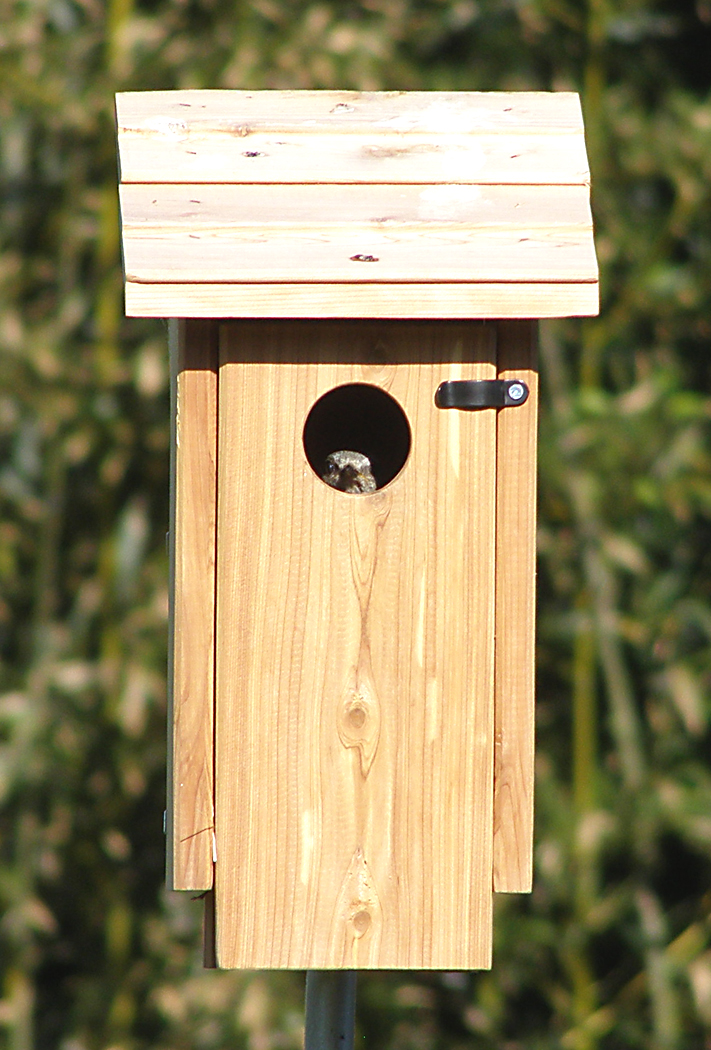
Bluebirds arrived and hijacked the box from the Tree Swallows. The photo to the right, taken that same day, shows the female Bluebird checking out the size of the hole on the box, with the male guarding her from the top.
Over the next week, the female added grass to the Tree
Swallow nest inside the box, heightening the sides of the nest.
By May 23rd, the female had laid five eggs.
In the meantime, we felt sorry for the Tree Swallows who had
been driven out of their nest. So we
mounted another nest box on May 19th about 75 feet from Box #1. We began to refer to this second nest box as Box #2.
 |
| Male Tree Swallow guarding Box #2 |
Only four days later, on May 23rd, to our great delight, a pair of Tree Swallows claimed Box #2!
The photo on the left shows the male Tree Swallow on top of Box #2 the following day.
The female Tree Swallow has
now laid at least five eggs, and the male stands guard duty most of the day while
the female incubates the eggs inside the box. Sometimes the male takes over incubating duty while the female leaves the box to feed on flying insects.
Unfortunately, there is not nearly as much activity around Box #1, the Bluebird box.
It seems that Ms. Bluebird has “flown the coop.” We don’t know why she is no longer around.
Perhaps she didn’t like my checking her nest, or perhaps she
didn’t think the male was taking very good care of her.
I would sometimes see the female Bluebird peeking out of the
nest box’s hole, which made me assume that she was incubating her eggs. The male would occasionally fly to the box
and feed her through the hole.
However, the male did not seem to be feeding the female very
often. One day the male came to the box,
fed the female through the hole, and then quickly flew from the box. To my surprise, the female immediately flew
out of the box after him!
It is said that in the Eastern Bluebird species, the female does all of the egg-incubating. If that is true, the eggs are not currently being incubated. My neighbor, however, has seen the male entering the nest box during the daytime. He therefore thinks the male is incubating the eggs. But I tend to think otherwise.
At any rate, as of this date, the male is still looking for his mate.
He has been perching on top of the
high fence post in the vicinity of the box, singing his beautiful song.
Sometimes he flies to the utility wire and
does the same. The photo to the left shows him on the fence post yesterday evening (June 8th).
The song of the Eastern Bluebird is the most beautiful bird song I've ever heard. It consists of a soft, subtle, melodious warble of several notes. If I were a musician, I would be able to describe it more fully, but the notes and rhythm remind me more of chimes than of vocal singing.
This evening (June 9th), Mr. Bluebird was again perching on the fence
post.
I slowly approached him, and then
sat down on the grass about 25 feet away.
He posed for me and allowed me to take numerous pictures of him.
It was actually too dark to get a good shutter speed; so I had to brighten this photo.
After perching on the fence post, Mr. Bluebird flew toward his nest box that still
contains the five eggs. Midway between
the post and the box, he did something that I never would have expected. He hovered in the air to get a better look at
me!
After Mr. Bluebird hovered for a few seconds, he landed on top of the nest box to see if I
was still looking at him. Again, he
obliged me by allowing me to take a couple of pictures of him.
Mr. Bluebird then flew to the front of the box and appeared
to go inside for a second as if to look for his mate.
Or, was he going inside the box to tell me his mate wasn’t
there? Although it can’t be proven, I
think that he was telling me so. He knew that I had been
watching him from the time he was on the post until the time he landed on the
box. I interpreted his hovering as his special way of getting my
attention and confirming that we were communicating.
It has now been 17 days since Ms. Bluebird laid the last of
her five eggs. With the average incubation period for Bluebirds being 14 to 15 days, the eggs should have hatched by now – that is, if the eggs
had been properly incubated.
In
a case like this, it is recommended to leave the eggs in the nest for a while
in case the female returns and begins incubating them. But given the fact that I have not seen the
female in a few days, I am thinking she is probably gone for good.
I
wonder if Mr. Bluebird will find a new mate or if a new pair of Bluebirds will
become interested in the nest box. Bluebirds are known to raise more than
one brood per season. After they raise their first brood in the
spring, they will usually start a second nest in June or early July.
I was halfway planning to clean
out the nest box tomorrow evening in case Mr. Bluebird finds a new mate, but
this evening, I received a “no” answer from him.
Just as I have been doing for the past few days, Mr. Bluebird still seems to be hoping
that Ms. Bluebird will return.
By the
fact that he was perching on top of the box while looking at me, and then quickly
entering and exiting the box, I think he was telling me that he wanted his mate
back.
He
might have even been telling me to go find his mate and bring her back to the
box!
So
it seems that Mr. Bluebird is still protecting his precious eggs, and they are
precious to me, too. For these reasons,
it does not seem like the proper time to clean out the box.
Poor
Mr. Bluebird! He is obviously mourning
for his mate, just as I have been.
But
Mr. Bluebird is teaching me something.
As depressed as I’ve been feeling about the eggs not hatching, my heart goes out in deep compassion to Mr. Bluebird.
After all, it is he who has lost his beloved mate.
In the meantime,
the Tree Swallows in Box #2 seem to be doing great.
I am thinking their eggs will start hatching around the time of the
summer Solstice or shortly thereafter.
You
can follow this blog to find out what happens with both the Bluebird box and the Tree Swallow box. Just enter your email address at top of the page on the right. That way, you will not miss the next episode!
I first began having intimate encounters with wild birds
when Barn Swallows nested on my porch during 2011 and 2012.
During those encounters, I became convinced
that humans and birds can develop meaningful rapports, communicate with each
other, and enjoy mutually beneficial relationships.
You can read about how one special Barn Swallow communicated to me in my book
Bonding with the Barn Swallows, available at Amazon at:
http://www.amazon.com/gp/product/1494481464/ref=as_li_tl?ie=UTF8&camp=1789&creative=390957&creativeASIN=1494481464&linkCode=as2&tag=barnswalfrie-20&linkId=5WME3VAHNSX3EXHH


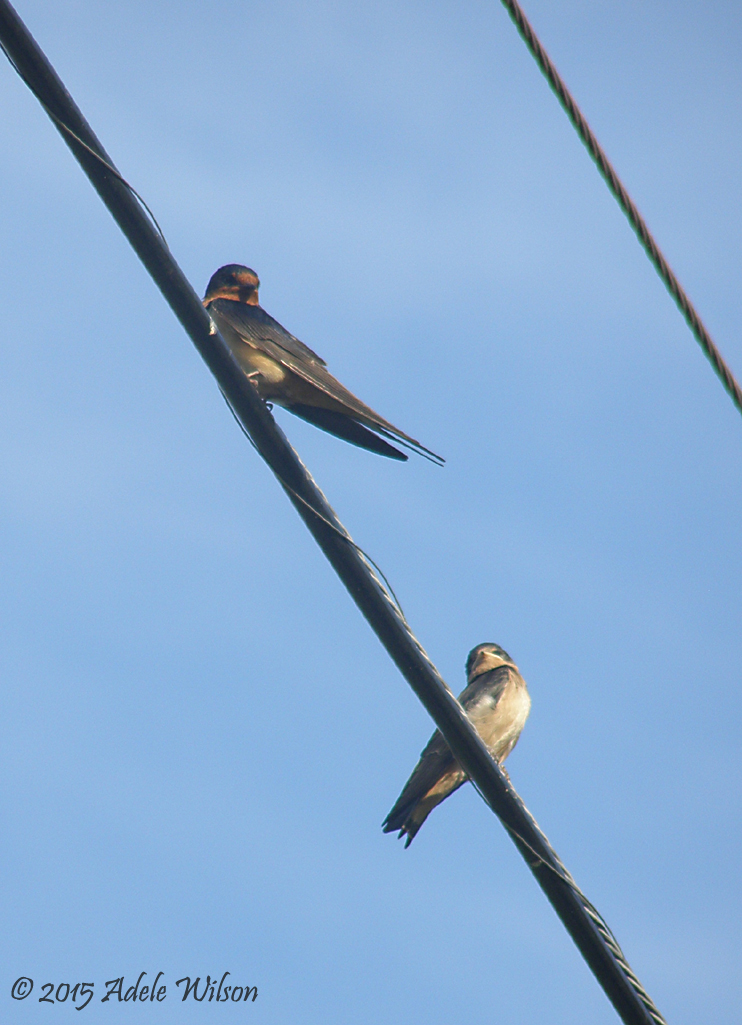 To the right are some juvenile Barn Swallows whom I was able to photograph on June 22nd. Although their wings are already rather long, their tail feathers have not yet grown to the adult length.
 If you have enjoyed these photos, you might want to check out the 117 photos in my book, Bonding with the Barn Swallows.
Many of them show close-ups of the baby Barn Swallows that were hatched
on my porch during 2011 and 2012. There are also photos of the parent
swallows guarding the nest and feeding their young. As an extra bonus,
the book includes photos of five different juvenile Barn Swallows, just
ten days after fledging. You
will be amazed at their varied markings. The book describes how one
special male Barn Swallow communicated to me by his body language on the
utility wire and how, only two days later, I discovered what he was
trying to tell me. The book is available by clicking on the image to the right.
If you have enjoyed these photos, you might want to check out the 117 photos in my book, Bonding with the Barn Swallows.
Many of them show close-ups of the baby Barn Swallows that were hatched
on my porch during 2011 and 2012. There are also photos of the parent
swallows guarding the nest and feeding their young. As an extra bonus,
the book includes photos of five different juvenile Barn Swallows, just
ten days after fledging. You
will be amazed at their varied markings. The book describes how one
special male Barn Swallow communicated to me by his body language on the
utility wire and how, only two days later, I discovered what he was
trying to tell me. The book is available by clicking on the image to the right.