Showing posts with label bluebirds. Show all posts

Wednesday, October 28, 2015

The Reappearance of the Bluebirds - Part I

Text and photos © 2015 Adele Wilson, author of Bonding with the Barn Swallows

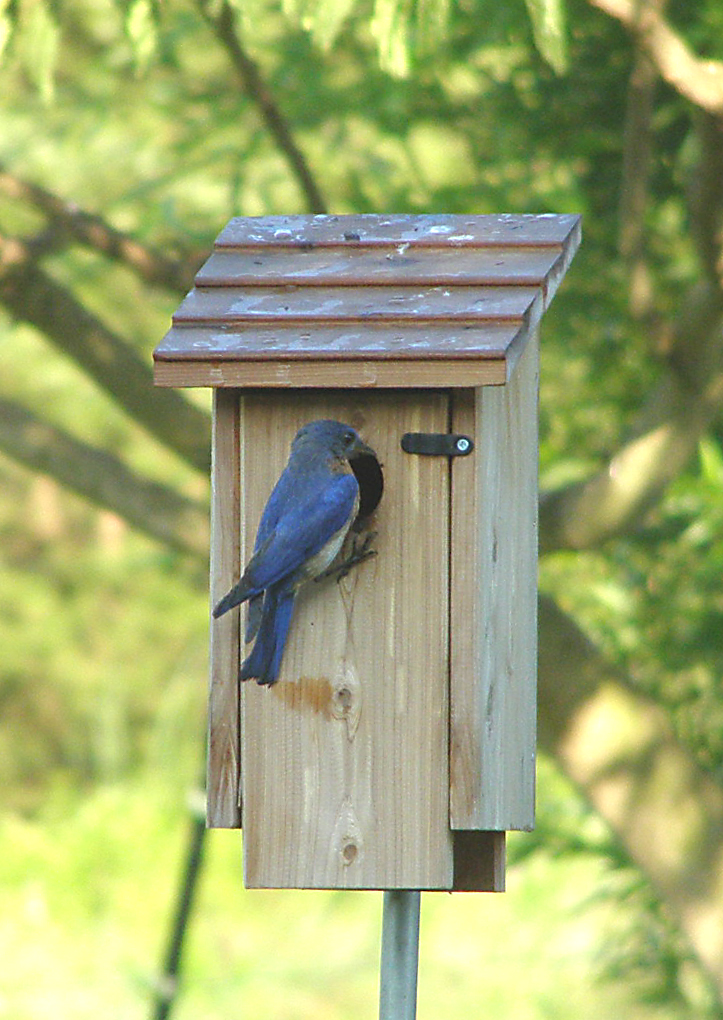
As you might remember, my neighbor mounted a Bluebird nest box in our yard last spring.  By the first week of July, four Bluebird babies had hatched in the box.  On the morning of July 22nd, I knew that the babies were due to leave the nest soon. 

Fortunately, it was sunny and clear that morning; so I went outside and took numerous photos of the parents feeding the babies inside the box.  A couple of the photos even showed a baby or two peeking out of the nest box hole.

That evening, to my great dismay, there were no Bluebirds around the box or its vicinity!  I checked the inside of the box and found no babies there.  The nest was compressed and quite unsanitary looking. 

Apparently, the babies had left the nest box (fledged) some time that day.  I was unprepared for this because I had calculated that the following day would be fledging day and I would have one more day to photograph the babies peeking out of the box.

Prior to this past July, my experience with observing baby birds in a nest had been limited to Barn Swallows, as I have described in my book, Bonding with the Barn Swallows.

Unlike baby Bluebirds, Barn Swallow babies, once they fledge, remain in the vicinity of their nest.  In the days following the fledging of Barn Swallow babies, I have often seen them high in the air, quickly flapping their wings as they practice flying.  They will often line up on the utility wires to rest and wait to be fed by their obliging parents.

Also unlike baby Bluebirds, baby Barn Swallows who have fledged during the morning will often return to the nest that night in order to rest from their long day.  Below is a photo from page 102 of my book, showing two baby Barn Swallows after they had returned to the nest the evening of the day that they fledged.  They looked so worn out that I thought they were about to expire!


To my great relief, however, after an hour had passed, the babies were sitting upright in the nest, looking like normal baby Barn Swallows.  They left the nest for good the following morning. 

But baby Bluebirds are “here today, gone tomorrow”.  They do not return to their nest once they have left it.  Their parents usher them into the trees for safety from predators.  Unable to feed themselves, the babies must depend on their parents to bring them insects for at least the next two weeks, just as the parents do while the babies are still in the nest.

I would have liked to have witnessed the fledging of the baby Bluebirds as an assurance that all four babies had made it out of the box safely.  We have a number of roaming, feral cats around here, and I was quite concerned that one or more of the babies had landed on the ground, making them vulnerable to predation.

A couple of mornings after fledging day, still not having seen any Bluebirds around, adult or young, I cleaned and sanitized the nest box. I had read that Bluebirds can raise two or three broods per season and that it might not be too late in the summer for the parent Bluebirds to start another brood.  I had also read that a pair of Bluebirds likes to have their box clean and their old nest removed before they re-nest in the same box.
 
But the parent Bluebirds did not return to their nesting area.  In fact, I did not see them anywhere!

I began searching the grounds of the property where I live for any sign of Bluebird fledglings.  But they were nowhere to be found.  Then I remembered, as previously stated, that parent Bluebirds take their newly-fledged babies into the woods to hide them from predators.  I had also read that, if the mama Bluebird decides to build a new nest, she will proceed to the nesting site and do so, leaving the papa to feed the young birds and teach them how to hunt.

In an intense desire to find out how many babies had made it safely to their new home in the woods, I continued to search the property, paying close attention to the trees that border it.  Finally, on the morning of July 31st, nine days after fledging day, I spotted a Bluebird on the wire above the neighbor’s property across the road.  It appeared to be an adult male, but all I could get was a blurry photo, as shown on the left.

July turned into August, but still, no Bluebirds.  Where were they?  By August 6th, the two-week period of the fledglings’ dependence on their parents for food had passed.  Had the fledglings survived?  Were they now learning to hunt on their own?

At long last, on the morning of August 21st, 30 days after the Bluebird babies had fledged, I spotted a couple of Bluebirds on the fence at the far corner of the property. They were perching several feet from one another, apparently searching for insects on the ground.

One of the birds (see photo on right) had a considerable amount of blue on its back, along with a rust color on the side of its breast. However, its plumage was visibility mottled with small patches of white, showing that the bird was losing some of its feathers in preparation for growing new ones.  This process is called "molting".

The bird looked like it might have been a juvenile in the process of gaining its adult plumage.  However, if indeed a juvenile, it had not been hatched in our nest box because it appeared to be too mature.  Perhaps it was an older juvenile that had fledged from another nest, possibly in early June.  It displayed too much solid-colored plumage to have been be young enough to have been one of our babies.

The second bird (photo, below left) had a familiar look to it. At first I thought it was a juvenile because of the white spots on its breast. But, again, the bird definitely looked too mature to have been one of the babies that had left our box on July 22nd.

The familiar look was not from the bird's plumage. Rather, the bird’s fierce stance and alert personality jogged my memory. The bird was acting exactly as our mama bird had acted while her babies were in the nest – proud, yet vigilant, and seemingly prepared to attack anyone who would dare to venture close to her nest.

Could this possibly have been our mama bird in molt?  The white spots could be indicating that she had been shedding her summer coat in preparation for gaining her winter plumage. 

Suddenly, the bird left the fence and quickly flew to the utility wire on the other side of our building. I walked around the building to get a better view of it. The bird allowed me to get a couple of photos but remained in an alarmed and vigilant state, as you can see from the photo below:


Yes, this was definitely our mama bird!  It had the same slate-colored head and upper back as our mama.  In addition, her beak was relatively long in Bluebird terms.  Mama had apparently recognized me while I was photographing her on the fence and must have become alarmed that I might be a threat to her young ones.  It was as if she had flown up to the wire to get a better view of me to be certain that I was not there to harm her or the other Bluebirds. 

So the mama was still alive!  I was extraordinarily relieved and hopeful that she had done a good job of protecting her young.  Given my observations of her personality over the summer, I assumed that she had done just that! 

On the right is a photo of Mama Bluebird that I had taken on July 16th while her babies were still in the nest box.  She was holding a worm in preparation to feed the babies, and you can see how long her beak was. She was exhibiting the same stern and vigilant stance as exhibited by the bird on the wire. Her plumage was a little more colorful in this photo because she still had her summer coat.

The next evening (August 22nd), I noticed some birds perching on the distant wires across the hay field from my driveway (see photo below).  The wires extend from a prominent, yet distant, telephone pole.  My best count was seven birds. Although the birds looked like black dots to my naked eyes, my binoculars soon revealed that they were Bluebirds!


One by one, a Bluebird would occasionally leave its perch on the wire and quickly swoop down to the ground, far below, to gather an insect.  Having harvested its prey, it would usually return to the wire to devour the insect.  Once in a while, however, I would see a bird carry its insect from the ground to the top of the telephone pole to smash the insect and make it more digestible, just as our mama and papa Bluebirds had done this past summer in order to prepare food for the youngsters.

The birds on the wire whose plumage patterns I could discern appeared to be adults.  But, were some of the birds juveniles?  I wondered if the visual acuity of a immature Bluebird would be sharp enough to allow it to be able to see an insect on the ground from the distance of a high utility wire.  I did not witness any of the birds feeding another bird, which made me assume that, if juveniles were included on the wire, they were old enough to feed themselves.

The questions remained:  Did all four chicks fledge successfully from our nest box and were they still alive?


The next day, August 23rd, I again ventured to the far corner of the property to see if I could find any juvenile Bluebirds.  It had been one month and one day since the babies had left the nest, and I had not yet seen a bird that could have been one of them. 

Well, it must have been my lucky day because, as I approached the fence, I was delighted to see a bird perching there, and yes, it proved to be a young Bluebird!  And it appeared to be the age that one of our babies would have reached by that time.


The photo at the above right shows the bird's "pin feathers", revealing it to be a juvenile.  And, judging by the bright blue feathers on the edge of its wing and part of its tail, it appeared to be a male.

The following day (August 24th), during the late afternoon, I was still determined to find more juvenile Bluebirds, if possible.  And I was not to be disappointed!


This time I spotted a juvenile female, as shown on the right side of the photo above. This particular juvenile appeared to be a female because her plumage lacked the blue that the previous day's juvenile male had displayed. You can see that the Bluebird on the left side of the photo is much more brightly colored.

As for the brightly colored Bluebird on the left side of the above photo, I could not discern its age. Despite the rich hues of its plumage, there were white spots throughout, indicating that the bird was molting. This bird was most likely the same bird I had seen on August 21st. Again, I could only guess that it was an older juvenile that fledged in June from another nest.

That same morning, I was able to get another photo, shown below, of the brightly colored bird. this time perched on a high fence post.  What a beautiful bright blue was on its wings and back!

Part II will include a description of a special event that occurred in September and a revelation about the identity of one of the Bluebirds I spotted in August. You can follow this blog and be notified of the next post by entering your email address in the upper right corner.


http://www.amazon.com/gp/product/1494481464/ref=as_li_tl?ie=UTF8&camp=1789&creative=390957&creativeASIN=1494481464&linkCode=as2&tag=barnswalfrie-20&linkId=6IUTK4EYNGUVGU6H
If you have found this story interesting, you might want to check out my book, Bonding with the Barn Swallows. Its 117 photos include close-ups of the baby Barn Swallows that were hatched on my porch during 2011 and 2012. There are also photos of the parent swallows guarding the nest and feeding their young. As an extra bonus, the book includes photos of five different juvenile Barn Swallows, just ten days after fledging. You will be amazed at their varied markings. The book describes how one special male Barn Swallow communicated to me by his body language on the utility wire and how, only two days later, I discovered what he was trying to tell me. To find out more about the book and read a preview, just click on the image to the right.


Friday, July 17, 2015

Nesting Bluebirds -- Bugs for the Babies!

Text and photos © 2015 Adele Wilson, author of Bonding with the Barn Swallows


The Bluebird eggs have hatched!  My estimation is that the hatching date was July 5th.  That would be the date of the hatching of the first egg.  Bluebird eggs are said to hatch within twenty-four hours of each other, although the last-laid egg might take a little longer.  The general rule is that all of the eggs will hatch within 48 hours of the first egg hatching, unless any of them are infertile. 

If you are interested in knowing how I estimated the hatching date, you can read the Technical Section below.

There were four eggs in the nest, and now there are four Bluebird babies.  I do not check the inside of the box very frequently for fear of stressing the parent Bluebirds.  The last time I checked, which was on Wednesday, July 15th, the babies had light-colored “pin feathers” on them.  Assuming a hatching date of July 5th, the first-hatched baby was ten days old at that time.

I have not photographed the babies, but if you go to the following site and look at Figure 5, you can see approximately what the babies looked like on July 15th:  http://www.wbu.com/chipperwoods/photos/ebluebird.htm.  Here’s another photo of 10-day-old Bluebirds:  http://www.sialis.org/images/series/ybb11thday.jpg.


As the babies grow larger, they need increasing amounts of food and higher frequencies of feeding.  Their food consists of bugs, more technically called insects, that the babies’ parents bring to the nest box.  On the right is a photo of Mama Bluebird with what might be a grasshopper in her beak.  She is preparing to feed at least one baby through the nest box hole when she feels that it is safe to do so.  The blossoms in the background are on a Mimosa tree.

Both parents have been diligently hunting for insects and bringing them to the box to feed to the babies.  The insects that Bluebirds eat are largely those that live on the ground.  A Bluebird will perch on a fence, a utility wire, or a building's roof and focus on the ground below.  Once it sees an insect, it will quickly swoop to the ground, capture the insect, and immediately return to its higher post to either digest the insect or save it to feed its youngsters.

The parent Bluebirds closely guard the nest box and for good reason.  We have roaming, feral cats around here that eat birds.  The parent Bluebirds probably also consider me to be a potential predator because they are extremely cautious about feeding their babies when I am taking pictures of them.

The photo on the left shows both Mama and Papa Bluebird on top of the box with insects in their beaks.  They are awaiting a safe time to feed their babies.

Mama Bluebird is more cautious than Papa Bluebird and likes to wait until I am out of the way before she feeds her babies.  I have very few photos, if any, of Mama feeding the babies though the nest box hole.

Finally, after a few minutes of both Mama and Papa Bluebird perching on top of the nest box, Papa Bluebird deemed it safe enough to feed his insect to the babies inside the box.  Mama stayed on top of the box awaiting her turn, as shown in the photo below.


The photo on the right, taken early in the morning, shows Papa Bluebird on top of the box holding an insect, a large one at that!  Since I was there with my camera, he was watching me to be certain that I would not interfere with his feeding of the babies.

I wondered how many babies that large insect would feed.  Interestingly, male Bluebirds are said to show preference for feeding the female babies instead of the males.  It is speculated that the Papa Bluebird would rather have the females grow up and be healthy because, unlike the males, they will not interfere with his breeding territory next spring.  Instead, the females will go off with their own mates into another territory.  In short, male Bluebirds compete for breeding territories, which are usually five or six acres in size, but they can sometimes range up to twenty acres.

Much of this information presented here can be found in the delightful book, Eastern Bluebird by Gary Ritchison, which I heartily recommend if you would like to find out more about Eastern Bluebirds.  The book is well illustrated with superb photos and contains a great deal of information.

After perching on top of the box and holding the huge insect in his beak, Papa Bluebird proceeded to feed the babies.  As the photo to the left shows, Papa landed on the front of the box and fed the insect to the babies inside. 

Immediately afterward, Papa actually went inside the box.  I was wondering what he was doing inside of the box, but a moment later I discovered what it was.

Papa Bluebird stayed inside the box for a short time and then exited from the box, flying away to hunt for another insect.  The photo below shows him flying from the box.  As to what Papa had been doing inside the box, the answer is shown in the photo.

If you look closely at the photo, you will see that Papa had something white in his beak.


Something white?  It was actually a form of a diaper.  It is called a “fecal sac” and is from one of the baby Bluebirds.  When the babies reach a certain age, it becomes the job of the parents to remove these sacs from the nest.

A parent will take the sac from the nest box and fly far away from the box.  The parent will drop the sac in a place where predators will not be able to associate the scent of the sac with the location of the nest box.  And that is what Papa Bluebird did.  I watched him fly across the adjacent field and out of sight with the sac still in his beak.

Technical Section

Estimating Eastern Bluebirds’ hatching dates is based on observations of the nest and certain knowledge of Bluebird behavior and breeding patterns.  It is necessary to know how many eggs are laid and when the female finishes laying them.  Here are my observations:

Afternoon of June 17th – no eggs in nest
Afternoon of June 21st – four eggs in nest
Afternoon of June 29th – four eggs in nest

Ornithological observations have shown that, once a female Bluebird starts laying eggs, she will lay one egg each morning.  This is also true of many other birds.  Bluebirds tend to lay their eggs well after sunrise, often between 8 and 10 a.m.

Also from observations, it is known that the female will usually start incubating her eggs either on the day that she lays her last egg or on the previous day.

Since no eggs were in the nest on the afternoon of June 17th, the female had not yet laid any eggs.  However, on June 21st there were four eggs in the nest, indicating that she had laid her first egg on June 18th, her second on June 19th, her third on June 20th, and her fourth on June 21st.

Since there were still only four eggs in the nest on June 29th, the female stopped laying after she laid her last egg on June 21st.  She therefore began incubating her eggs either on June 21st or on June 20th. 

For the purpose of my calculation, I assumed that the female began incubating on June 21st. That is because I did not notice the female peeking her head out of the nest box prior to the morning of June 21st. Peeking her head out of the box would have indicated that she had been in the box all night keeping the eggs warm. Instead, early each morning prior to June 21st, between about 6 and 7 a.m., I observed the male landing on top of the box, the female flying from the fence to the top of the box to join him, after which the male would enter the box with the female following him. The male would then fly out of the box, leaving the female inside. I interpreted this behavior as the male escorting the female inside the box to make sure it was safe to lay an egg.

Since the average incubation period for Eastern Bluebirds is fourteen days, I assumed that the eggs began hatching on July 5th, which was fourteen days from June 21st.

Based on the assumption that the oldest baby was ten days old on July 15th, I estimate that babies will start fledging (leaving the nest) sometime around July 23rd. This is based on the average fledging date for Eastern Bluebirds being the date when they are eighteen days old. However, this can vary up to twenty-one days. On the other hand, the material that I have read about Eastern Bluebird nesting in this region of the U.S. has indicated an average of 18 days.

Stay tuned to discover the fate of the babies!  And please pray with me that they will be safe once they leave the nest.  To follow this blog, you can enter your email address on the upper right of the page.
 
http://www.amazon.com/gp/product/1494481464/ref=as_li_tl?ie=UTF8&camp=1789&creative=390957&creativeASIN=1494481464&linkCode=as2&tag=barnswalfrie-20&linkId=EROSZIVV5QWFVCHR
If you have found this story interesting, you might want to check out my book, Bonding with the Barn Swallows.  Its 117 photos include closeups of the baby Barn Swallows that were hatched on my porch during 2011 and 2012.  There are also photos of the parent swallows guarding the nest and feeding their young.  As an extra bonus, the book includes photos of five different juvenile Barn Swallows, just ten days after fledging.  You will be amazed at their varied markings.  The book describes how one special male Barn Swallow communicated to me by his body language on the utility wire and how, only two days later, I discovered what he was trying to tell me.  To find out more about the book and read a preview, just click on the image to the right.


Sunday, June 28, 2015

Bluebird Egg Incubation in Progress!

Text and photos © 2015 Adele Wilson, author of Bonding with the Barn Swallows

Wonderful news!  The female Eastern Bluebird is still incubating her eggs.  That's a good thing because our temperatures have been cool for the last couple of days.

This morning, from a distance of about 20 feet (6 meters), I was trying to photograph the nest box with the female Bluebird inside.  Suddenly, unbeknownst to me while I was pressing the shutter, the male Bluebird landed on the top of the box with a worm in his beak!  If you look carefully at the photo on the upper right, you might be able to see a hint of the female Bluebird's head inside the box.

Apparently, the male Bluebird trusts me.  This does not overly surprise me because he often stations himself in one spot and watches me for quite a long time.  The other day, he perched on the fence and observed me the whole time while I was refilling the bird feeders.

Below is a close-up of the male Bluebird holding the worm.  In the background you can see blooms on a mimosa tree.


The male Bluebird had not flown to the box just to feed himself.  As the photo on the right shows, he flew to the entrance hole of the box and proceeded to feed his mate, who was still inside the box.

So far, so good!  I am hoping that this nesting attempt will be successful without the female abandoning her eggs as the first female did.

I do not know how many eggs are currently in the nest, but on Sunday, June 21st, there were four eggs.  Once I feel that it is safe to check the inside of the box without scaring the female Bluebird away, I will find out how many eggs she has laid.  From that information, and assuming that she laid one egg per morning (as is usually the case), I should be able to calculate approximately when the eggs should start hatching.

A female Bluebird is said to begin full-time incubation of her eggs either on the day she lays her last egg or on the preceding day.  So, once I find out how many eggs are currently in the nest, I can calculate the approximate date on which the eggs should begin to hatch.  In the following paragraphs I shall describe how this calculation is performed.

For instance, if I find that there are currently five eggs in the nest, knowing that the female laid her fourth egg on June 21st, and assuming that she laid one egg on each successive morning, I can assume that she laid her last egg on the morning of June 22nd.  If there are six eggs currently in the nest, the assumption would be that she laid her last egg on June 23rd.  The average number of eggs in a Bluebird clutch is five, but that number can sometimes be as high as seven.

In the former case (if there are five eggs currently in the nest), the female would have begun incubating her eggs either on June 22nd or on the preceding day.  In the latter case (six eggs currently in the nest), the female would have begun incubating either on June 23rd or on the preceding day.

The final bit of knowledge required in order to estimate the hatching date is that the average incubation period for Eastern Bluebirds is fourteen to fifteen days.  Therefore, assuming that there are no more than six eggs currently in the nest, the eggs should begin hatching sometime between July 5th and July 8th.

To the right is a photo of what Eastern Bluebird eggs look like.  I took this photo on June 6th after the first female had abandoned the nest.  She had not been in the area or inside the nest box for several days.  The eggs were due to hatch soon, but she had not incubated them.  These eggs disappeared within a few days after the new female arrived on June 12th.  My assumption at this point is that the new female removed them.

All of the eggs in a Bluebird clutch are said to hatch within one or two days of each other.  Once the hatching date(s) are known, the ages of the nestlings can be calculated, and that is the most important thing to know in the monitoring of Bluebird boxes.

It is important to be able to track the ages of the nestlings in order to avoid opening the box when the chicks are twelve or more days old.  Opening the box during this time period can cause the premature fledging of one or more of the chicks, which could result in their demise.

All for now!  You can follow this blog by entering your email address in the upper right corner of the top of this page.

http://www.amazon.com/gp/product/1494481464/ref=as_li_tl?ie=UTF8&camp=1789&creative=390957&creativeASIN=1494481464&linkCode=as2&tag=barnswalfrie-20&linkId=A2XPLUWAXC4RLY2F
If you have found this story interesting, you might want to check out my book, Bonding with the Barn Swallows.  Its 117 photos include closeups of the baby Barn Swallows that were hatched on my porch during 2011 and 2012.  There are also photos of the parent swallows guarding the nest and feeding their young.  As an extra bonus, the book includes photos of five different juvenile Barn Swallows, just ten days after fledging.  You will be amazed at their varied markings.  The book describes how one special male Barn Swallow communicated to me by his body language on the utility wire and how, only two days later, I discovered what he was trying to tell me.  To find out more about the book and read a preview, just click on the image to the right. 


Monday, June 22, 2015

The Case of the Disappearing Eggs

Text and photos © 2015 Adele Wilson, author of Bonding with the Barn Swallows


Unhatched Bluebird Eggs

Bluebird pair, May 12, 2015
If you are following this blog, you know that a pair of Eastern Bluebirds began nesting in Box #1 on May 10th.  The photo to the right shows the male and female Bluebirds on May 12th.  The female is holding straw to carry into the box.

The female Bluebird laid five eggs, one per day, beginning on May 19th.  However, as of June 6th, I had not seen the female around for a couple of days.  I did not observe her presence on the following days, either.

The five eggs never hatched.  It had become obvious that the female Bluebird had abandoned her nest without having incubated her eggs.

[Note:  At the end of this post is a timetable giving significant dates and observations.]


Tree Swallow Eggs

In the meantime, a pair of Tree Swallows had begun nesting in Box #2 on May 19th and the female had begun laying eggs on May 28th.  By June 3rd when I checked the box, I saw at least five Tree Swallow eggs.  There could even have been additional eggs that were being obscured by a feather.

Male on fence, female peeking out of box
Unlike the Bluebirds, the Tree Swallows were diligently incubating their eggs and protecting their nest.  Each day from my porch I would observe the male Tree Swallow guarding the box while perching on the fence several feet away from it.  The female would be inside the box, often peeking out of the entrance hole.  When the female went out to catch food, the male would take over incubation duty.

On June 9th, I checked the Tree Swallow box again.  The female was inside the box, but flew from it when I was about 5 feet (1.5 meters) away.  I opened the door and held a mirror above the nest, but all I saw was a heap of feathers.

Tree Swallows typically use feathers to cushion and protect their eggs; so I was not surprised.  However, I decided not to tamper with the feathers for fear of alarming the birds.  After all, from my observation on June 3rd, I already knew that the nest contained at least five eggs.

The New Bluebird Nest  

New female Bluebird, June 12, 2015
The male Bluebird continued hanging around the Bluebird box, even after his mate had left the premises and abandoned the eggs.  Fortunately, as described in my previous post, a new female Bluebird arrived at the box on June 12th.  What an exciting day that was!

The new female began carrying straw into the box, a sign that she was building her own nest on top of the old nest, that is, the nest that had been built by the previous female.

On June 15th, I decided to check the Bluebird box.  I opened the door, held up a mirror, and was shocked by what I saw.  All five unhatched eggs laid by the previous female were missing!

I was dumbfounded.  Had the eggs been removed by a predator – perhaps a bird, a snake, or even a human?

It had been a clean removal.  There was no evidence of crushed eggs.  There were no eggshells in the nest or on the ground below the box.  Eggshells or crushed eggs would have been evidence of a raccoon, sparrow, wren, or possibly a cat, having preyed upon the eggs.
  
I frantically began researching Bluebird nesting behavior.  I discovered that, when a new female Bluebird arrives at a previously built nest that contains unhatched eggs, she will either build a nest directly on top of the old eggs or remove the eggs and continue adding to the previously built nest.

The fact that the old, unhatched eggs had disappeared from the nest in such a clean, sanitary way therefore led me to consider the possibility that the new female had removed them.  At any rate, it was just as well that the old eggs had been removed because it freed me from the decision of whether to remove them or not.

Barring the possibility that a human had been responsible for the removal of the eggs, the only other type of predator that could have removed the eggs so cleanly would have been a rat snake.  Both of our bird boxes are mounted on 3/8-inch (0.95 cm) diameter poles, 4 to 5 feet (1.2 to 1.5 meters) above the ground.  Both boxes’ entrance holes are 1 9/16 inches (4 cm) in diameter.  The poles do not have predator guards; so predation by a rat snack could have been a possibility.

However, despite the fact that three different species of birds have nested on my porch each summer since 2011, I have never seen a rat snake on or near the premises.  I will “never say never”, though.

I concluded that when the new female Bluebird arrived on June 12th and began adding straw to the old nest, she decided to do some thorough house cleaning.  She must have removed the old female Bluebird’s unhatched eggs in preparation to lay her own.

That seemed like reasonable explanation for the old Bluebird eggs disappearing.

Checking the Tree Swallow Nest – the Surprise

On June 15th, just a moment after I had checked the Bluebird box (Box #1) and discovered that the unhatched Bluebird eggs were missing, I walked over to Box #2 to check the Tree Swallow nest.  As usual, the male Tree Swallow was perched near the box and the female was inside the box peeking through the hole.

But there was something very different occurring this time.  The female Tree Swallow inside the box was acting unusually jittery and skittish.  She was extremely alarmed that I was approaching her nest.  The photo to the left shows the way the female would usually look when she was peeking out of the box.  But on this day, I could see her twitching her head and scurrying about on the inside of the box.

I decided not to try to open the door on the Tree Swallow box.  The female Tree Swallow would have certainly flown from the box, but I didn’t want to upset her any further.

A day later, on June 16th, I decided it was again time to try to check the Tree Swallow box.  Based on my calculations of egg-laying dates and incubation times, the Tree Swallow eggs should have started hatching by that date.

To my dismay, the Tree Swallows were nowhere near their box.  Strangely, neither the male nor the female Tree Swallow had been around all day.  Each day for the past three weeks both the male and female Tree Swallows had been fiercely guarding their box.  But that was not the case today. 

I walked to the box, opened the door, held up a mirror, and saw what to me was a ghastly sight.  The nest was completely bare – no feathers, no eggs!!!
There was no evidence of the eggs having been pierced or crushed, and there were no eggs or fragments of eggs on the ground below the box.  The bottom of the nest was clean.  It had been a sanitary removal, identical to the removal of the eggs in the Bluebird box.

My conclusion was that whatever entity removed the eggs from the Bluebird box also removed the eggs from the Tree Swallow box.

Again, I thought about the possibility of a rat snake preying upon both sets of eggs – those in the Bluebird box and those in the Tree Swallow box.  The thought made me cringe.

The Aftermath – Thoughts and Theories

I became extremely depressed.  Now that the Tree Swallows had left the premises, there would be no birds around to swoop at would-be predators.  There are a number of feral cats roaming around, and the Tree Swallows had been doing a good job of keeping them at bay.


The photo above, from May 20th, shows the Tree Swallow box in the background with the Bluebird box in the foreground.  Although the photo does not show it well, the Tree Swallow box is about 75 feet (23 meters) from the Bluebird box.  We had tried to mount the Tree Swallow box at a closer distance, as is often recommended by Bluebird and Tree Swallow organizations, but we were unable to do so.  A distance of 6 feet (1.8 meters) from the Bluebird box had been thwarted because of a rock bed directly under the ground surface, and other locations were restricted by our landlord due to grass-mowing concerns.

Besides, the Tree Swallows had been able to happily nest in their box during the time period when the original female Bluebird had laid her eggs.  It was only a few days after the new female Bluebird arrived that the Tree Swallow eggs went missing.

New female Bluebird, June 14, 2015
Perhaps the new female Bluebird is more vigilant and cautious than was the previous female.  My theory so far is that the previous female was relatively inexperienced at nesting, while the new female is perhaps a little older in age and more aware of the hazards than can exist when nesting close to other birds.  Perhaps, therefore, the new female Bluebird had not only removed the old eggs from her box, but had also, in her desire to have no other birds nesting near her own nest, removed the eggs from the Tree Swallow box.

I have observed some different behavior by the new female that leads me to believe that she is indeed more experienced, and I will cover this behavior in a future post.

On June 18th, I removed the Tree Swallow nest from Box #2 and thoroughly cleaned the box with a 10% bleach solution from a spray bottle.  The box ended up being soaked, and on top of that we had a fair amount of rain afterwards.  I then decided to have my neighbor take the Tree Swallow box down for a couple of days so that I could bring it inside to dry out.  On the morning of June 21st, I remounted the box.

Time will tell if there is an egg predation problem occurring in this neighborhood.  If the new female Bluebird lays eggs and the eggs remain undisturbed, it will lessen the possibility that a rat snake or human preyed upon the eggs in both nests.  You can follow this blog to find out what becomes of the new Bluebird nest and whether other birds decide to nest in the now-empty Tree Swallow box.  All you have to do is enter your email address at the top right of this page.


Timetable:

May 10th – Bluebirds arrive at Box #1
May 19th – Female Bluebird lays the first of 5 eggs
May 19th – Tree Swallows arrive at Box #2
May 23rd – Female Bluebird lays last egg, incubation supposedly begins
May 28th – Female Tree Swallow lays the first of at least 5 eggs
June 6th – Female Bluebird has not been around for a couple of days, 5 unhatched eggs still in nest
June 12th – New female Bluebird arrives
June 15th – Discovery that unhatched Bluebird eggs had been removed from Bluebird nest
June 16th – Discovery that Tree Swallow eggs had been removed from Tree Swallow nest
 

http://www.amazon.com/gp/product/1494481464/ref=as_li_tl?ie=UTF8&camp=1789&creative=390957&creativeASIN=1494481464&linkCode=as2&tag=barnswalfrie-20&linkId=3WNC52VLO64CM3A7
If you have found this story interesting, you might want to check out my book, Bonding with the Barn Swallows.  Its 117 photos include closeups of the baby Barn Swallows that were hatched on my porch during 2011 and 2012.  There are also photos of the parent swallows guarding the nest and feeding their young.  As an extra bonus, the book includes photos of five different juvenile Barn Swallows, just ten days after fledging.  You will be amazed at their varied markings.  The book describes how one special male Barn Swallow communicated to me by his body language on the utility wire and how, only two days later, I discovered what he was trying to tell me.  To find out more about the book and read a preview, just click on the image to the right.