Showing posts with label eastern us. Show all posts

Friday, July 17, 2015

Nesting Bluebirds -- Bugs for the Babies!

Text and photos © 2015 Adele Wilson, author of Bonding with the Barn Swallows


The Bluebird eggs have hatched!  My estimation is that the hatching date was July 5th.  That would be the date of the hatching of the first egg.  Bluebird eggs are said to hatch within twenty-four hours of each other, although the last-laid egg might take a little longer.  The general rule is that all of the eggs will hatch within 48 hours of the first egg hatching, unless any of them are infertile. 

If you are interested in knowing how I estimated the hatching date, you can read the Technical Section below.

There were four eggs in the nest, and now there are four Bluebird babies.  I do not check the inside of the box very frequently for fear of stressing the parent Bluebirds.  The last time I checked, which was on Wednesday, July 15th, the babies had light-colored “pin feathers” on them.  Assuming a hatching date of July 5th, the first-hatched baby was ten days old at that time.

I have not photographed the babies, but if you go to the following site and look at Figure 5, you can see approximately what the babies looked like on July 15thhttp://www.wbu.com/chipperwoods/photos/ebluebird.htm.  Here’s another photo of 10-day-old Bluebirds:  http://www.sialis.org/images/series/ybb11thday.jpg.


As the babies grow larger, they need increasing amounts of food and higher frequencies of feeding.  Their food consists of bugs, more technically called insects, that the babies’ parents bring to the nest box.  On the right is a photo of Mama Bluebird with what might be a grasshopper in her beak.  She is preparing to feed at least one baby through the nest box hole when she feels that it is safe to do so.  The blossoms in the background are on a Mimosa tree.

Both parents have been diligently hunting for insects and bringing them to the box to feed to the babies.  The insects that Bluebirds eat are largely those that live on the ground.  A Bluebird will perch on a fence, a utility wire, or a building's roof and focus on the ground below.  Once it sees an insect, it will quickly swoop to the ground, capture the insect, and immediately return to its higher post to either digest the insect or save it to feed its youngsters.

The parent Bluebirds closely guard the nest box and for good reason.  We have roaming, feral cats around here that eat birds.  The parent Bluebirds probably also consider me to be a potential predator because they are extremely cautious about feeding their babies when I am taking pictures of them.

The photo on the left shows both Mama and Papa Bluebird on top of the box with insects in their beaks.  They are awaiting a safe time to feed their babies.

Mama Bluebird is more cautious than Papa Bluebird and likes to wait until I am out of the way before she feeds her babies.  I have very few photos, if any, of Mama feeding the babies though the nest box hole.

Finally, after a few minutes of both Mama and Papa Bluebird perching on top of the nest box, Papa Bluebird deemed it safe enough to feed his insect to the babies inside the box.  Mama stayed on top of the box awaiting her turn, as shown in the photo below.


The photo on the right, taken early in the morning, shows Papa Bluebird on top of the box holding an insect, a large one at that!  Since I was there with my camera, he was watching me to be certain that I would not interfere with his feeding of the babies.

I wondered how many babies that large insect would feed.  Interestingly, male Bluebirds are said to show preference for feeding the female babies instead of the males.  It is speculated that the Papa Bluebird would rather have the females grow up and be healthy because, unlike the males, they will not interfere with his breeding territory next spring.  Instead, the females will go off with their own mates into another territory.  In short, male Bluebirds compete for breeding territories, which are usually five or six acres in size, but they can sometimes range up to twenty acres.

Much of this information presented here can be found in the delightful book, Eastern Bluebird by Gary Ritchison, which I heartily recommend if you would like to find out more about Eastern Bluebirds.  The book is well illustrated with superb photos and contains a great deal of information.
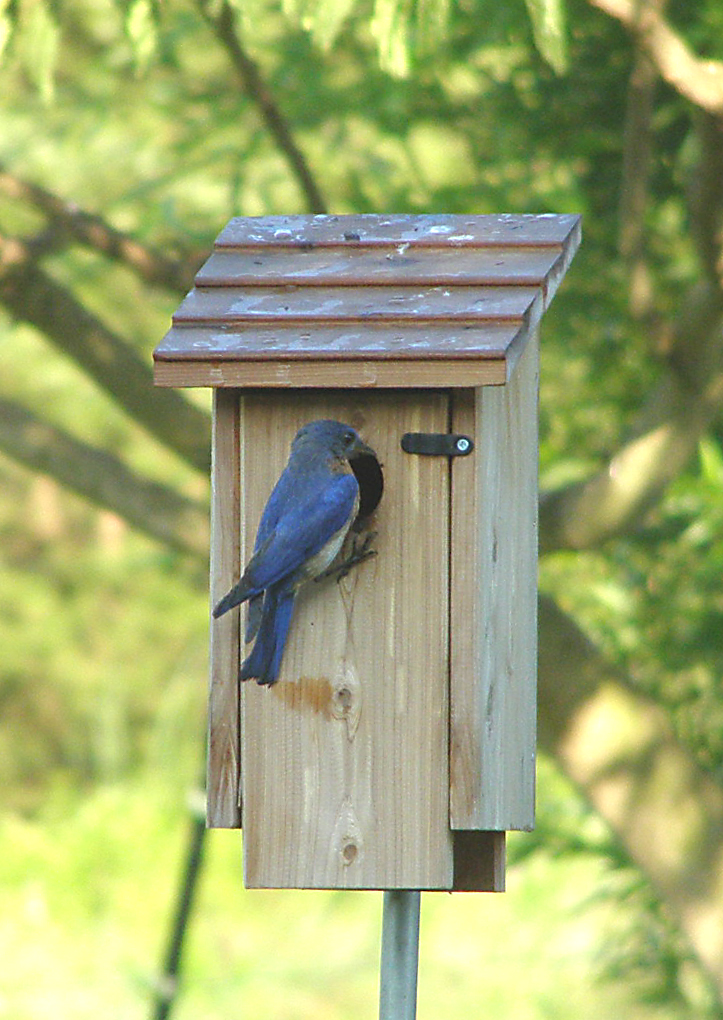
After perching on top of the box and holding the huge insect in his beak, Papa Bluebird proceeded to feed the babies.  As the photo to the left shows, Papa landed on the front of the box and fed the insect to the babies inside. 

Immediately afterward, Papa actually went inside the box.  I was wondering what he was doing inside of the box, but a moment later I discovered what it was.

Papa Bluebird stayed inside the box for a short time and then exited from the box, flying away to hunt for another insect.  The photo below shows him flying from the box.  As to what Papa had been doing inside the box, the answer is shown in the photo.

If you look closely at the photo, you will see that Papa had something white in his beak.


Something white?  It was actually a form of a diaper.  It is called a “fecal sac” and is from one of the baby Bluebirds.  When the babies reach a certain age, it becomes the job of the parents to remove these sacs from the nest.

A parent will take the sac from the nest box and fly far away from the box.  The parent will drop the sac in a place where predators will not be able to associate the scent of the sac with the location of the nest box.  And that is what Papa Bluebird did.  I watched him fly across the adjacent field and out of sight with the sac still in his beak.

Technical Section

Estimating Eastern Bluebirds’ hatching dates is based on observations of the nest and certain knowledge of Bluebird behavior and breeding patterns.  It is necessary to know how many eggs are laid and when the female finishes laying them.  Here are my observations:

Afternoon of June 17th – no eggs in nest
Afternoon of June 21st – four eggs in nest
Afternoon of June 29th – four eggs in nest

Ornithological observations have shown that, once a female Bluebird starts laying eggs, she will lay one egg each morning.  This is also true of many other birds.  Bluebirds tend to lay their eggs well after sunrise, often between 8 and 10 a.m.

Also from observations, it is known that the female will usually start incubating her eggs either on the day that she lays her last egg or on the previous day.

Since no eggs were in the nest on the afternoon of June 17th, the female had not yet laid any eggs.  However, on June 21st there were four eggs in the nest, indicating that she had laid her first egg on June 18th, her second on June 19th, her third on June 20th, and her fourth on June 21st.

Since there were still only four eggs in the nest on June 29th, the female stopped laying after she laid her last egg on June 21st.  She therefore began incubating her eggs either on June 21st or on June 20th. 

For the purpose of my calculation, I assumed that the female began incubating on June 21st. That is because I did not notice the female peeking her head out of the nest box prior to the morning of June 21st. Peeking her head out of the box would have indicated that she had been in the box all night keeping the eggs warm. Instead, early each morning prior to June 21st, between about 6 and 7 a.m., I observed the male landing on top of the box, the female flying from the fence to the top of the box to join him, after which the male would enter the box with the female following him. The male would then fly out of the box, leaving the female inside. I interpreted this behavior as the male escorting the female inside the box to make sure it was safe to lay an egg.

Since the average incubation period for Eastern Bluebirds is fourteen days, I assumed that the eggs began hatching on July 5th, which was fourteen days from June 21st.

Based on the assumption that the oldest baby was ten days old on July 15th, I estimate that babies will start fledging (leaving the nest) sometime around July 23rd. This is based on the average fledging date for Eastern Bluebirds being the date when they are eighteen days old. However, this can vary up to twenty-one days. On the other hand, the material that I have read about Eastern Bluebird nesting in this region of the U.S. has indicated an average of 18 days.

Stay tuned to discover the fate of the babies!  And please pray with me that they will be safe once they leave the nest.  To follow this blog, you can enter your email address on the upper right of the page.
 
http://www.amazon.com/gp/product/1494481464/ref=as_li_tl?ie=UTF8&camp=1789&creative=390957&creativeASIN=1494481464&linkCode=as2&tag=barnswalfrie-20&linkId=EROSZIVV5QWFVCHR
If you have found this story interesting, you might want to check out my book, Bonding with the Barn Swallows.  Its 117 photos include closeups of the baby Barn Swallows that were hatched on my porch during 2011 and 2012.  There are also photos of the parent swallows guarding the nest and feeding their young.  As an extra bonus, the book includes photos of five different juvenile Barn Swallows, just ten days after fledging.  You will be amazed at their varied markings.  The book describes how one special male Barn Swallow communicated to me by his body language on the utility wire and how, only two days later, I discovered what he was trying to tell me.  To find out more about the book and read a preview, just click on the image to the right.


Sunday, June 28, 2015

Bluebird Egg Incubation in Progress!

Text and photos © 2015 Adele Wilson, author of Bonding with the Barn Swallows

Wonderful news!  The female Eastern Bluebird is still incubating her eggs.  That's a good thing because our temperatures have been cool for the last couple of days.

This morning, from a distance of about 20 feet (6 meters), I was trying to photograph the nest box with the female Bluebird inside.  Suddenly, unbeknownst to me while I was pressing the shutter, the male Bluebird landed on the top of the box with a worm in his beak!  If you look carefully at the photo on the upper right, you might be able to see a hint of the female Bluebird's head inside the box.

Apparently, the male Bluebird trusts me.  This does not overly surprise me because he often stations himself in one spot and watches me for quite a long time.  The other day, he perched on the fence and observed me the whole time while I was refilling the bird feeders.

Below is a close-up of the male Bluebird holding the worm.  In the background you can see blooms on a mimosa tree.


The male Bluebird had not flown to the box just to feed himself.  As the photo on the right shows, he flew to the entrance hole of the box and proceeded to feed his mate, who was still inside the box.

So far, so good!  I am hoping that this nesting attempt will be successful without the female abandoning her eggs as the first female did.

I do not know how many eggs are currently in the nest, but on Sunday, June 21st, there were four eggs.  Once I feel that it is safe to check the inside of the box without scaring the female Bluebird away, I will find out how many eggs she has laid.  From that information, and assuming that she laid one egg per morning (as is usually the case), I should be able to calculate approximately when the eggs should start hatching.

A female Bluebird is said to begin full-time incubation of her eggs either on the day she lays her last egg or on the preceding day.  So, once I find out how many eggs are currently in the nest, I can calculate the approximate date on which the eggs should begin to hatch.  In the following paragraphs I shall describe how this calculation is performed.

For instance, if I find that there are currently five eggs in the nest, knowing that the female laid her fourth egg on June 21st, and assuming that she laid one egg on each successive morning, I can assume that she laid her last egg on the morning of June 22nd.  If there are six eggs currently in the nest, the assumption would be that she laid her last egg on June 23rd.  The average number of eggs in a Bluebird clutch is five, but that number can sometimes be as high as seven.

In the former case (if there are five eggs currently in the nest), the female would have begun incubating her eggs either on June 22nd or on the preceding day.  In the latter case (six eggs currently in the nest), the female would have begun incubating either on June 23rd or on the preceding day.

The final bit of knowledge required in order to estimate the hatching date is that the average incubation period for Eastern Bluebirds is fourteen to fifteen days.  Therefore, assuming that there are no more than six eggs currently in the nest, the eggs should begin hatching sometime between July 5th and July 8th.

To the right is a photo of what Eastern Bluebird eggs look like.  I took this photo on June 6th after the first female had abandoned the nest.  She had not been in the area or inside the nest box for several days.  The eggs were due to hatch soon, but she had not incubated them.  These eggs disappeared within a few days after the new female arrived on June 12th.  My assumption at this point is that the new female removed them.

All of the eggs in a Bluebird clutch are said to hatch within one or two days of each other.  Once the hatching date(s) are known, the ages of the nestlings can be calculated, and that is the most important thing to know in the monitoring of Bluebird boxes.

It is important to be able to track the ages of the nestlings in order to avoid opening the box when the chicks are twelve or more days old.  Opening the box during this time period can cause the premature fledging of one or more of the chicks, which could result in their demise.

All for now!  You can follow this blog by entering your email address in the upper right corner of the top of this page.

http://www.amazon.com/gp/product/1494481464/ref=as_li_tl?ie=UTF8&camp=1789&creative=390957&creativeASIN=1494481464&linkCode=as2&tag=barnswalfrie-20&linkId=A2XPLUWAXC4RLY2F
If you have found this story interesting, you might want to check out my book, Bonding with the Barn Swallows.  Its 117 photos include closeups of the baby Barn Swallows that were hatched on my porch during 2011 and 2012.  There are also photos of the parent swallows guarding the nest and feeding their young.  As an extra bonus, the book includes photos of five different juvenile Barn Swallows, just ten days after fledging.  You will be amazed at their varied markings.  The book describes how one special male Barn Swallow communicated to me by his body language on the utility wire and how, only two days later, I discovered what he was trying to tell me.  To find out more about the book and read a preview, just click on the image to the right. 


Friday, November 21, 2014

Adventures in Bird Feeding, Part 2: The Majestic Blue Jays

http://www.amazon.com/gp/product/1494481464/ref=as_li_tl?ie=UTF8&camp=1789&creative=9325&creativeASIN=1494481464&linkCode=as2&tag=barnswalfrie-20&linkId=JNK4O4JMGK2QOCOUby Adele Barger Wilson, author of Bonding with the Barn Swallows
Photos and text © 2014 Adele Wilson


Here in Eastern West Virginia, as well as in much of the Eastern and Central U.S., we have three beautifully colored bird species that stay around all winter -- Blue Jays, Cardinals, and Eastern Bluebirds.  This post will focus on Blue Jays.

The plumage of the Blue Jay is probably the most fascinating of all of our local birds.  While the Blue Jay's breast is a light blue color and its face a whitish blue, its crest, upper wings, and the back of its head all exhibit a brilliant solid blue. 

The black accents on the Blue Jay's face add to its mystique.  What truly gives this bird its unique appearance, however, is the mosaic pattern on its lower wings and tail, consisting of tones ranging from mid blue to bright turquoise, amazingly interspersed with black and white.

During the first winter that I put out suet cakes, I would hang the cakes from a redbud tree that was growing beside my porch.  My landlord had transplanted the tree from the woods years ago.

Blue Jay on Redbud Tree
It was my first experience in hanging out a suet feeder; so I did not know what to expect.  To my delight, among those who came to feast on the suet cakes that winter were the majestic Blue Jays.

Unfortunately, the redbud tree seemed to be developing a disease.  Its trunk had split open, and the branches were starting to split, also.  The following summer, my landlord chopped it down.

And so it was that during the following winter I no longer had a tree beside my porch.  I was forced to put the suet cakes on a different tree, one that was farther away.  That was the “tree by the driveway” that I mentioned in Part 1.

Unfortunately, no Blue Jays came to my suet feeders on the tree by the driveway.  I didn't know exactly why this was.  I suspected that it had something to do with the Blue Jays being able to find food that other people had put out for them.

For one thing, Blue Jays LOVE peanuts in the shell, in other words, whole peanuts.  They also love shelled peanuts and shelled or unshelled sunflower seeds.  Shelled sunflower seeds come in two varieties – striped and black oil – and Blue Jays love them both.  Cracking shells is no problem for these birds.

http://www.amazon.com/gp/product/B0036GWPUI/ref=as_li_tl?ie=UTF8&camp=1789&creative=390957&creativeASIN=B0036GWPUI&linkCode=as2&tag=barnswalfrie-20&linkId=63GFENIFT2675Z6X
Blue Jay Peanut Feeder
Here is an example of a feeder that Blue Jays would love – perfect for peanuts in the shell!  You can click on the image to find out more.  Unfortunately, with the high winds around here, I have nowhere to hang such a feeder.  Hung from the tree by the driveway, it could easily hit a parked vehicle if the wind were to blow it down.  The only other choice would be the mimosa tree, whose branches are too delicate to hold it intact.


http://www.amazon.com/gp/product/B000V4L13K/ref=as_li_tl?ie=UTF8&camp=1789&creative=390957&creativeASIN=B000V4L13K&linkCode=as2&tag=barnswalfrie-20&linkId=XSZBEISZNG5EM34U
Peanuts in the Shell

And here is a good source of Peanuts in the shell to attract not only Blue Jays, but also other birds such as Titmice, Chickadees, and Nuthatches.  If you click on the image, you can find out how to order this 10 lb supply of unshelled peanuts.


Although I was concerned that the local Blue Jay population had somehow undergone a dire fate, I was nevertheless relieved that the Blue Jays were not competing with the other birds at the feeders.  As beautiful as they are, Blue Jays often bully the smaller birds and prevent them from eating.  But I still wondered what had happened to them.


Blue Jays gathering acorns
In early October, I went to visit a friend who has a huge oak tree in front of his house.  As I approached his door, I saw a dozen or more Blue Jays momentarily perching on the branches of the oak tree, and then quickly swooping to the ground. 

I soon observed that the Blue Jays were knocking acorns, one-by-one, from the tree.  Each time a Blue Jay would dislodge an acorn, it would quickly leave its branch and fly down to the ground to retrieve it.  Once it had gathered the acorn in its beak, it would suddenly lift off and fly over the building and out of sight.

Blue Jay gathering acorns
But the Blue Jays kept returning to the oak tree to gather more acorns.  Again, each bird would first land on a branch, knock an acorn to the ground below, and then swoop to the ground to pick it up.

Soon I noticed that the Blue Jays’ mouths looked conspicuously full.  Their checks were bulged out, as if they were holding more than one acorn at a time.  Upon looking more carefully, I noticed that, besides gathering acorns, they were also gathering unshelled peanuts!

The mystery was soon solved when my friend’s next-door neighbor told me that her grandson had thrown peanuts out on the lawn to feed the squirrels.  Little did she know that the peanuts would attract Blue Jays!

I later read that Blue Jays will actually bury acorns and peanuts for safe keeping, much as squirrels do! They will eat some of the acorns immediately, but save the others to bury and find later during the cold winter months.

One day I was wondering if we still had Blue Jays in our neighborhood.  On a couple of occasions during the summer, I had identified a couple of these birds through binoculars on the neighbor’s property, quickly flitting from trees to fences, then briefly to the ground, and then up again into the trees.  But they had never come close to my feeders and I had not seen them since those two occasions.

During my regular backyard bird watches, I began using binoculars to view the distant trees.  Over a period of time, I began to notice movement --- flashes of blue light moving from tree to tree.  Upon realizing that the most of the trees were oaks, it suddenly dawned on me that those flashes of light must be Blue Jays!

What a relief it was to know that our Blue Jay neighbors had not perished!  Thanks to my newly gained knowledge of these birds’ love for acorns, I had learned where to look for Blue Jays -- on or near oak trees!  And, despite the absence of Blue Jays at my feeders, it is consoling to know that we still have these marvelous wonders of the Avian Kingdom around us. 

Here are some gift suggestions that feature the awesome beauty of the Blue Jay.  You can click on the images to find out more:

http://www.amazon.com/gp/product/B00B8A8VPM/ref=as_li_tl?ie=UTF8&camp=1789&creative=390957&creativeASIN=B00B8A8VPM&linkCode=as2&tag=barnswalfrie-20&linkId=SEWQQPGV2COH4BRB
Suncatcher - Beautiful!

http://www.amazon.com/gp/product/B00KVTCPQM/ref=as_li_tl?ie=UTF8&camp=1789&creative=390957&creativeASIN=B00KVTCPQM&linkCode=as2&tag=barnswalfrie-20&linkId=ETYXJNNLBVQV5L33
Blue Jay on Snowy Branch - Charming Figurine!
http://www.amazon.com/gp/product/B00F46BRSO/ref=as_li_tl?ie=UTF8&camp=1789&creative=390957&creativeASIN=B00F46BRSO&linkCode=as2&tag=barnswalfrie-20&linkId=X4XKWOJZH4AVK22K
Enameled Box - Inlaid Czech Crystals
http://www.amazon.com/gp/product/B00N120G7G/ref=as_li_tl?ie=UTF8&camp=1789&creative=390957&creativeASIN=B00N120G7G&linkCode=as2&tag=barnswalfrie-20&linkId=UK24FNYQOFQALTL5
Porcelain Christmas Ornament - Gorgeous!


http://www.amazon.com/gp/product/B00JBZ99H0/ref=as_li_tl?ie=UTF8&camp=1789&creative=390957&creativeASIN=B00JBZ99H0&linkCode=as2&tag=barnswalfrie-20&linkId=H3WBL2D6GQDPXS7W
Blue Jay Feeder - Sunset Vista Designs

http://www.amazon.com/gp/product/B009TCNEA8/ref=as_li_tl?ie=UTF8&camp=1789&creative=390957&creativeASIN=B009TCNEA8&linkCode=as2&tag=barnswalfrie-20&linkId=QXNPFQFEMYRQHPBA
Clip Christmas Tree Ornaments (2)