Friday, November 21, 2014

Adventures in Bird Feeding, Part 2: The Majestic Blue Jays

http://www.amazon.com/gp/product/1494481464/ref=as_li_tl?ie=UTF8&camp=1789&creative=9325&creativeASIN=1494481464&linkCode=as2&tag=barnswalfrie-20&linkId=JNK4O4JMGK2QOCOUby Adele Barger Wilson, author of Bonding with the Barn Swallows
Photos and text © 2014 Adele Wilson


Here in Eastern West Virginia, as well as in much of the Eastern and Central U.S., we have three beautifully colored bird species that stay around all winter -- Blue Jays, Cardinals, and Eastern Bluebirds.  This post will focus on Blue Jays.

The plumage of the Blue Jay is probably the most fascinating of all of our local birds.  While the Blue Jay's breast is a light blue color and its face a whitish blue, its crest, upper wings, and the back of its head all exhibit a brilliant solid blue. 

The black accents on the Blue Jay's face add to its mystique.  What truly gives this bird its unique appearance, however, is the mosaic pattern on its lower wings and tail, consisting of tones ranging from mid blue to bright turquoise, amazingly interspersed with black and white.

During the first winter that I put out suet cakes, I would hang the cakes from a redbud tree that was growing beside my porch.  My landlord had transplanted the tree from the woods years ago.

Blue Jay on Redbud Tree
It was my first experience in hanging out a suet feeder; so I did not know what to expect.  To my delight, among those who came to feast on the suet cakes that winter were the majestic Blue Jays.

Unfortunately, the redbud tree seemed to be developing a disease.  Its trunk had split open, and the branches were starting to split, also.  The following summer, my landlord chopped it down.

And so it was that during the following winter I no longer had a tree beside my porch.  I was forced to put the suet cakes on a different tree, one that was farther away.  That was the “tree by the driveway” that I mentioned in Part 1.

Unfortunately, no Blue Jays came to my suet feeders on the tree by the driveway.  I didn't know exactly why this was.  I suspected that it had something to do with the Blue Jays being able to find food that other people had put out for them.

For one thing, Blue Jays LOVE peanuts in the shell, in other words, whole peanuts.  They also love shelled peanuts and shelled or unshelled sunflower seeds.  Shelled sunflower seeds come in two varieties – striped and black oil – and Blue Jays love them both.  Cracking shells is no problem for these birds.

http://www.amazon.com/gp/product/B0036GWPUI/ref=as_li_tl?ie=UTF8&camp=1789&creative=390957&creativeASIN=B0036GWPUI&linkCode=as2&tag=barnswalfrie-20&linkId=63GFENIFT2675Z6X
Blue Jay Peanut Feeder
Here is an example of a feeder that Blue Jays would love – perfect for peanuts in the shell!  You can click on the image to find out more.  Unfortunately, with the high winds around here, I have nowhere to hang such a feeder.  Hung from the tree by the driveway, it could easily hit a parked vehicle if the wind were to blow it down.  The only other choice would be the mimosa tree, whose branches are too delicate to hold it intact.


http://www.amazon.com/gp/product/B000V4L13K/ref=as_li_tl?ie=UTF8&camp=1789&creative=390957&creativeASIN=B000V4L13K&linkCode=as2&tag=barnswalfrie-20&linkId=XSZBEISZNG5EM34U
Peanuts in the Shell

And here is a good source of Peanuts in the shell to attract not only Blue Jays, but also other birds such as Titmice, Chickadees, and Nuthatches.  If you click on the image, you can find out how to order this 10 lb supply of unshelled peanuts.


Although I was concerned that the local Blue Jay population had somehow undergone a dire fate, I was nevertheless relieved that the Blue Jays were not competing with the other birds at the feeders.  As beautiful as they are, Blue Jays often bully the smaller birds and prevent them from eating.  But I still wondered what had happened to them.


Blue Jays gathering acorns
In early October, I went to visit a friend who has a huge oak tree in front of his house.  As I approached his door, I saw a dozen or more Blue Jays momentarily perching on the branches of the oak tree, and then quickly swooping to the ground. 

I soon observed that the Blue Jays were knocking acorns, one-by-one, from the tree.  Each time a Blue Jay would dislodge an acorn, it would quickly leave its branch and fly down to the ground to retrieve it.  Once it had gathered the acorn in its beak, it would suddenly lift off and fly over the building and out of sight.

Blue Jay gathering acorns
But the Blue Jays kept returning to the oak tree to gather more acorns.  Again, each bird would first land on a branch, knock an acorn to the ground below, and then swoop to the ground to pick it up.

Soon I noticed that the Blue Jays’ mouths looked conspicuously full.  Their checks were bulged out, as if they were holding more than one acorn at a time.  Upon looking more carefully, I noticed that, besides gathering acorns, they were also gathering unshelled peanuts!

The mystery was soon solved when my friend’s next-door neighbor told me that her grandson had thrown peanuts out on the lawn to feed the squirrels.  Little did she know that the peanuts would attract Blue Jays!

I later read that Blue Jays will actually bury acorns and peanuts for safe keeping, much as squirrels do! They will eat some of the acorns immediately, but save the others to bury and find later during the cold winter months.

One day I was wondering if we still had Blue Jays in our neighborhood.  On a couple of occasions during the summer, I had identified a couple of these birds through binoculars on the neighbor’s property, quickly flitting from trees to fences, then briefly to the ground, and then up again into the trees.  But they had never come close to my feeders and I had not seen them since those two occasions.

During my regular backyard bird watches, I began using binoculars to view the distant trees.  Over a period of time, I began to notice movement --- flashes of blue light moving from tree to tree.  Upon realizing that the most of the trees were oaks, it suddenly dawned on me that those flashes of light must be Blue Jays!

What a relief it was to know that our Blue Jay neighbors had not perished!  Thanks to my newly gained knowledge of these birds’ love for acorns, I had learned where to look for Blue Jays -- on or near oak trees!  And, despite the absence of Blue Jays at my feeders, it is consoling to know that we still have these marvelous wonders of the Avian Kingdom around us. 

Here are some gift suggestions that feature the awesome beauty of the Blue Jay.  You can click on the images to find out more:

http://www.amazon.com/gp/product/B00B8A8VPM/ref=as_li_tl?ie=UTF8&camp=1789&creative=390957&creativeASIN=B00B8A8VPM&linkCode=as2&tag=barnswalfrie-20&linkId=SEWQQPGV2COH4BRB
Suncatcher - Beautiful!

http://www.amazon.com/gp/product/B00KVTCPQM/ref=as_li_tl?ie=UTF8&camp=1789&creative=390957&creativeASIN=B00KVTCPQM&linkCode=as2&tag=barnswalfrie-20&linkId=ETYXJNNLBVQV5L33
Blue Jay on Snowy Branch - Charming Figurine!
http://www.amazon.com/gp/product/B00F46BRSO/ref=as_li_tl?ie=UTF8&camp=1789&creative=390957&creativeASIN=B00F46BRSO&linkCode=as2&tag=barnswalfrie-20&linkId=X4XKWOJZH4AVK22K
Enameled Box - Inlaid Czech Crystals
http://www.amazon.com/gp/product/B00N120G7G/ref=as_li_tl?ie=UTF8&camp=1789&creative=390957&creativeASIN=B00N120G7G&linkCode=as2&tag=barnswalfrie-20&linkId=UK24FNYQOFQALTL5
Porcelain Christmas Ornament - Gorgeous!


http://www.amazon.com/gp/product/B00JBZ99H0/ref=as_li_tl?ie=UTF8&camp=1789&creative=390957&creativeASIN=B00JBZ99H0&linkCode=as2&tag=barnswalfrie-20&linkId=H3WBL2D6GQDPXS7W
Blue Jay Feeder - Sunset Vista Designs

http://www.amazon.com/gp/product/B009TCNEA8/ref=as_li_tl?ie=UTF8&camp=1789&creative=390957&creativeASIN=B009TCNEA8&linkCode=as2&tag=barnswalfrie-20&linkId=QXNPFQFEMYRQHPBA
Clip Christmas Tree Ornaments (2)

Wednesday, November 19, 2014

Adventures in Bird Feeding, Part 1: Keeping Peace with the Mockingbirds


http://www.amazon.com/gp/product/1494481464/ref=as_li_tl?ie=UTF8&camp=1789&creative=9325&creativeASIN=1494481464&linkCode=as2&tag=barnswalfrie-20&linkId=JNK4O4JMGK2QOCOUby Adele Barger Wilson, author of Bonding with the Barn Swallows
Photos and text © 2014 Adele Wilson

This is Part 1 of a series on my experiences with feeding wild birds in my back yard.  I reside in the eastern mountains of the United States, in what might be termed "Central Appalachia".  Here in eastern West Virginia we have many of the typical eastern U.S. birds who make their homes here during the winter.

This post will focus on how I feed the birds and my experiences in dealing with Mockingbirds.

WHAT I FEED THE BIRDS

Traditionally, people have thought of seeds as major bird food.  And it is true that many birds depend on seeds in the winter.

However, I have had to refrain from putting out feeders containing loose seeds because I rent from a landlord who could well be concerned about overspill of seeds from a feeder.  When spring comes, these seeds could possibly germinate and cause weeds to sprout.

Therefore, any seeds that I put out are contained in suet mixtures that have been compressed into suet cakes.  These cakes can easily be placed in “suet cages” and hung where birds can find them.

For further information about suet cages, or “baskets” as they are sometimes called, you can click on this image:
 http://www.amazon.com/gp/product/B000HHLZH8/ref=as_li_tl?ie=UTF8&camp=1789&creative=390957&creativeASIN=B000HHLZH8&linkCode=as2&tag=barnswalfrie-20&linkId=HB53LY6QX53WT5KG

During the winter of 2013-2014, I had two suet feeders hanging from the tree next to my driveway.  The tree became a welcome feeding station for Cardinals, Tufted Titmice, House Finches, Chickadees, Dark-Eyed Juncos, Sparrows, Wrens, Woodpeckers and Nuthatches.  Here is a Dark-Eyed Junco at the top of a feeder with a Tufted Titmouse clinging to the left side:


In my experience, at least with the birds that make their homes here during the winter, the best all-around suet cakes to attract a variety of birds have been cakes containing black oil sunflower seed.  Cardinals love these, as do the Woodpeckers.  Even the Chickadees and other birds will grab a seed and then fly to a higher branch to crack the seed and consume it.  Here is an example of a suet cake containing black oil sunflower seeds:
http://www.amazon.com/gp/product/B004G5YL32/ref=as_li_tl?ie=UTF8&camp=1789&creative=390957&creativeASIN=B004G5YL32&linkCode=as2&tag=barnswalfrie-20&linkId=XDLMTI4MWXTDYJEX

ENTER THE MOCKINGBIRDS

As winter turned to spring, I began to see Mockingbirds.  I didn’t often see them on the suet feeders, but it was a common occurrence to see a Mockingbird conspicuously posted either on the tree where the feeders were hanging, or on a nearby fence or wire.  My thought was that the Mockingbirds were staking out and defending their newly formed territories.  Or perhaps they had built a nest in the vicinity, and were therefore guarding their eggs or young.

On a couple of occasions during the month of May, I was surprised to see a Mockingbird eating from one of the suet feeders.  I had never observed Mockingbirds feeding from suet cakes before.  Upon raising the question on Bird Forum, I learned that other people had also observed this and that Mockingbirds are generally omnivores, eating from a wide variety of sources, one of which can be suet cakes.  This photo is from May 8, 2014:


By late May, Grackles and Starlings were arriving by the dozens, often devouring at least one suet cake per day.  I could not afford to keep replacing the cakes; so I left the suet cages up but did not refill them.  Besides, I thought, now that the weather was warm, the birds could start finding food on their own.

The Mockingbirds continued to make their presence known, even more overtly than during previous weeks.  On most occasions when I stepped out on my porch, a Mockingbird would appear and sound its alarm call, the same alarm call that it would voice in response to a cat roaming the area.  

I came to regard the Mockingbirds as the self-appointed sentinels of the neighborhood.  If I didn’t see one immediately upon setting foot on my porch, camera in hand, one would soon appear in plain sight, as if asking to be photographed.  Proud and confident, it would hold its ground and stay in one position, allowing me to take numerous shots.  This photo is from June 5, 2014:


All summer long, the Mockingbirds guarded their territory.  At the start of my walks around the neighborhood, I would almost always see a Mockingbird posted on a fence, tree, utility wire, or the top of the building, staring at me as if it thought that I was threatening to take over its territory (photo from August 20, 2014):


In mid-October, with cold weather approaching, I decided it was time to put out the suet cakes again.  The suet cages on the tree by the driveway had withstood the high winds of our summer storms and were still intact, hanging from their same positions as they had been hanging last spring.

Since some of our daytime temperatures were still as high as 60 to 70 degrees F, I decided to insert peanut butter, no-melt cakes into the cages.  However, after observing the cakes for a few days, I noticed that they were barely being eaten.  They hung for weeks, and I rarely saw any birds on or near them – except for Mockingbirds.

Then I noticed that the Mockingbirds were actually guarding the suet feeders!  When any other type of bird would land on the tree, the Mockingbirds would chase it away.

Suet cage feeders are advantageous for small birds that can cling to the sides and bottoms of the feeders while they eat.  But with the Mockingbirds guarding the feeders, the smaller birds didn’t stand a chance of getting that close to them. 

Small birds can also perch on the tops of the suet feeders.  However, larger birds, such as Grackles, Blue Jays, and Mockingbirds, in order to partake of the suet mixture, MUST either perch on top of a suet feeder or on a lower branch, if there is one, from which they can reach the cake.

Here is a Mockingbird eating from the feeder on October 20th.  Since there was no branch below or beside the feeder on which to perch, the Mockingbird was forced to perch on the top of the feeder.  You can see that the Mockingbird seems to be straining to eat from the feeder, having to contort itself to get to the suet.


The only types of birds who were availing themselves of the suet cakes were the Mockingbirds.  But even the Mockingbirds were rarely eating from them.  It seemed that the Mockingbirds were partaking of the cakes not because they had to, but merely as a demonstration to the other birds that they were the sole owners of not only the feeders, but the entire tree from which the feeders were hanging!

The no-melt peanut butter cakes were getting old, so I decided to replace them with the black oil sunflower seed type that had proved to be so popular with the birds last winter and spring:
http://www.amazon.com/gp/product/B004G5YL32/ref=as_li_tl?ie=UTF8&camp=1789&creative=390957&creativeASIN=B004G5YL32&linkCode=as2&tag=barnswalfrie-20&linkId=XDLMTI4MWXTDYJEX

However, even the two suet cakes of this type were not being eaten.  On several mornings I witnessed a pair of Cardinals approaching the tree where the cakes were hanging, only to be quickly chased away from the area by the Mockingbirds. Here is a Mockingbird standing guard on the tree where the suet feeders were hanging (photo from October 26, 2014):


Perplexed and frustrated by the Mockingbirds disallowing the other birds from eating from the cakes, I decided to research the matter.  I subsequently read an article stating that sometimes Mockingbirds do indeed perceive certain feeders as parts of their territory.  It went on to state that since the Mockingbirds feel that they own the feeders, they will chase all other birds away from them, preventing the other birds from feeding.

One of the suggested remedies is to put the feeders up in another location.  Hopefully, that other location would not be in the Mockingbirds’ territory, and the other birds will be free to feed there.

Since there were two suet feeders hanging on the tree by the driveway, I decided to keep one of them on that tree and move the other to another tree.  My reasoning behind leaving one on the tree by the driveway was to give the Mockingbirds something to continue to guard.  

And indeed, the Mockingbirds were continuing to guard the feeder on the tree by the driveway.  They seemed to be cooperating in allowing each other to eat.  On November 11th, one Mockingbird was guarding the feeder while the other bird was eating from it!


The tree on which I placed the second feeder is a mimosa tree some 50 to 60 feet from the tree by the driveway.  Even if the mimosa tree were part of the Mockingbirds’ territory, I thought, the Mockingbirds would have a difficult time guarding two trees at once.

For about ten days I rarely saw a bird at the newly located suet feeder on the mimosa tree.  Again, I was disappointed to be unable to feed the Cardinals, House Finches, and other birds that I had regularly seen last winter.  Perhaps the Mockingbirds were also guarding that tree.

Finally, on November 15th, I saw a House Finch feeding from the newly located feeder.  What a relief it was to realize that at least one bird had found the feeder!


Generally, all it takes it one bird finding a feeder in order for the other birds to follow.  Soon I started seeing Tufted Titmice, Chickadees, and Cardinals eating from the newly located feeder on the mimosa tree.

On the morning of November 16th, I was thrilled to see three female Cardinals on the mimosa tree, with one of them voraciously eating from the suet cake. 

One of the three Cardinals was perched near the top of the tree.  While viewing her through binoculars, I noticed a Mockingbird perched near her on the topmost branch.

Oh no, I thought, the Mockingbirds are now aware of the new location of one of the suet feeders!  Yet, the Mockingbird was merely perching there, allowing one of the Cardinals to eat and the other two to perch on other branches in order to await their turns at the feeder.

So, at least for the time being, I was convinced that the mimosa tree was out of the range of the Mockingbirds’ territory and that the other birds were free to eat from the feeder on that tree.

For the last couple of days, our weather has been unseasonably cold, more similar to our weather in January and February than to November.  At night, the temperatures have dipped well below freezing and sometimes stayed below freezing in the daytime.  During the few times that I have ventured outdoors, I have not seen any Mockingbirds.

Now that I am thinking about it, I do not remember seeing any Mockingbirds in my yard during the many weeks of snow cover that we had last winter.  At this time, we have not yet had snow, but perhaps the bitter cold weather has forced our Mockingbirds to leave the neighborhood.  If that is the case, the Mockingbird problem has been solved, and both trees have been freed for the other birds to eat!

November 22, 2014 - Read the latest update:
Update on the Mockingbirds - Are they still interfering?

http://www.amazon.com/gp/product/0547152469/ref=as_li_tl?ie=UTF8&camp=1789&creative=390957&creativeASIN=0547152469&linkCode=as2&tag=barnswalfrie-20&linkId=QIK35EUF4EMMLYKTFuture posts will feature further adventures in winter bird feeding.  In the meantime, here is the book that has been most valuable to me in identifying our Eastern U.S. birds:  The Peterson Field Guide to Birds of Eastern and Central North America.

This book contains superb illustrations by Roger Tory Peterson that brilliantly illustrate plumage markings on specific bird species.  The text, also by Roger Tory Peterson, excellently explains not only the markings, but also the voices and calls of the different birds, in addition to their typical habitats.  The section on each bird contains a reference to its range map in the back part of the book.  From this you can find out if the bird is specific to your region.


Wednesday, November 12, 2014

Barn Swallow Art - Ideas for Holiday Gifts

http://www.amazon.com/gp/product/1494481464/ref=as_li_tl?ie=UTF8&camp=1789&creative=9325&creativeASIN=1494481464&linkCode=as2&tag=barnswalfrie-20&linkId=JNK4O4JMGK2QOCOUby Adele Barger Wilson, author of Bonding with the Barn Swallows 

If you live in the Northern Hemisphere, you probably aren't seeing any Barn Swallows these days.  That is because Barn Swallows migrate to warmer locations for the winter, generally in the Southern Hemisphere.

But you can have Barn Swallows on your walls to bring their delightful energy into your home all year round!  Or perhaps you are shopping for holiday gifts and someone who loves Barn Swallows is on your list.  All of the art below is readily available for purchase.  Just click on the pictures to find out more!


Baby Barn Swallows Giclée Art Print
By Betsy LaMere
16” x 10.6”, 24” x 16”,
32” x 21.3”, or 48” x 32”
http://www.amazon.com/gp/product/B00NRPPGV8/ref=as_li_tl?ie=UTF8&camp=1789&creative=390957&creativeASIN=B00NRPPGV8&linkCode=as2&tag=barnswalfrie-20&linkId=CAFQOYJV7LRENRL7

River Scene with Barn Swallows
Fine Art Print on Canvas
By Karl Bodmer
12” x 9”, 16” x 13”,
20” x 16”, or 24” x 19”


http://www.amazon.com/gp/product/B00K8F5QCO/ref=as_li_tl?ie=UTF8&camp=1789&creative=390957&creativeASIN=B00K8F5QCO&linkCode=as2&tag=barnswalfrie-20&linkId=TEBHSNS7HGNSAQQU

Barn or Chimney Swallow
By John James Audubon
Paper Giclée
12” x 18” or 24” x 36”


http://www.amazon.com/gp/product/B00IJJRIDQ/ref=as_li_tl?ie=UTF8&camp=1789&creative=390957&creativeASIN=B00IJJRIDQ&linkCode=as2&tag=barnswalfrie-20&linkId=HJ2EQARJNKVWVIRK

Barn or Chimney Swallow
By John James Audubon
7” x 10”, matted to 11” x 14”
http://www.amazon.com/gp/product/B0081RT8IO/ref=as_li_tl?ie=UTF8&camp=1789&creative=390957&creativeASIN=B0081RT8IO&linkCode=as2&tag=barnswalfrie-20&linkId=MCMSLAMCXAJDU36I

Barn Swallow Window Poster
13” x 19”
By Chris Vest


http://www.amazon.com/gp/product/B00KC6T2FQ/ref=as_li_tl?ie=UTF8&camp=1789&creative=390957&creativeASIN=B00KC6T2FQ&linkCode=as2&tag=barnswalfrie-20&linkId=PJZE5YO5EYCGAMM7

Barn Swallow Flying
Wall Decal
18" x 15"


http://www.amazon.com/gp/product/B004720KCU/ref=as_li_tl?ie=UTF8&camp=1789&creative=390957&creativeASIN=B004720KCU&linkCode=as2&tag=barnswalfrie-20&linkId=LRVVQXFLADMMUDYP

Barn Swallow Ceramic Tile Coasters
Set of 4


http://www.amazon.com/gp/product/B00AWETLAO/ref=as_li_tl?ie=UTF8&camp=1789&creative=390957&creativeASIN=B00AWETLAO&linkCode=as2&tag=barnswalfrie-20&linkId=FEZPNNFYMDAGZMET
Four Barn Swallows Sitting on a Perch
(White Background)
Peel and Stick Removable Wall Decal
18 inches x 10 inches

http://www.amazon.com/gp/product/B00C49W7TW/ref=as_li_tl?ie=UTF8&camp=1789&creative=390957&creativeASIN=B00C49W7TW&linkCode=as2&tag=barnswalfrie-20&linkId=P2CSQSSKW4P2RZT3
Barn Swallow on Perch
Peel and Stick Removable Wall Decal
Horizontal
18 inches x 13 inches


http://www.amazon.com/gp/product/B00C4A0RWU/ref=as_li_tl?ie=UTF8&camp=1789&creative=9325&creativeASIN=B00C4A0RWU&linkCode=as2&tag=barnswalfrie-20&linkId=WWMYRH7F2BCRSE2D
Barn Swallow on Perch
Peel and Stick Removable Wall Decal
Vertical
24 inches x 17 inches


http://www.amazon.com/gp/product/B00EA7P16C/ref=as_li_tl?ie=UTF8&camp=1789&creative=390957&creativeASIN=B00EA7P16C&linkCode=as2&tag=barnswalfrie-20&linkId=GYEAFTFYOY5DVTSN

Barn Swallow by John James Audubon
17 inches x 23 inches
Giclee Art Print
Framed and ready to hang


Sunday, November 9, 2014

Why Bluebirds?

http://www.amazon.com/gp/product/1494481464/ref=as_li_tl?ie=UTF8&camp=1789&creative=9325&creativeASIN=1494481464&linkCode=as2&tag=barnswalfrie-20&linkId=JNK4O4JMGK2QOCOU
by Adele Barger Wilson, author of Bonding with the Barn Swallows
Photos and text © 2014 Adele Wilson


The Bluebirds are getting friendlier toward me.  The last few mornings while I have been standing on my porch, they have been landing on the utility wire above my driveway, apparently just to take a look at me!  To the left is a photo from this morning.

In my last post, I promised that in this post I would reveal the reason that I began seeing Bluebirds in my neighborhood during the summer of 2013.  (As explained in that post, our Bluebirds are of the Eastern Bluebird species; so my references to "Bluebirds" refer to Eastern Bluebirds.)

As you may remember, I had not seen any Bluebirds in this area for eighteen years.  Yet, on July 29, 2013, I sighted my first baby Bluebirds.  They were just over the fence from my driveway in my neighbors' horse pasture.  I could not identify them at first, but I sent a photo to the Maryland Bluebird Society who confirmed that they were juvenile Eastern Bluebirds.

As of August 29, 2013, I was still seeing baby Bluebirds:


After that date, I continued seeing Bluebirds in my neighborhood -- mostly babies during that summer, but more adults as the summer ended.  I was wondering how late in the season I would continue seeing Bluebirds.  That was because an Eastern Bluebird range map was showing that, in this region of the U.S., these birds tend to migrate south when cold weather arrives.

Yet, I continued seeing Bluebirds and photographing them in November and December.  Even on January 20th, I have a record of seeing one.  I continued to photograph them in February and March.

So, I found out that our Bluebirds do indeed stay around during the winter.  But the question was:  Why, all of a sudden, did I begin seeing them in 2013 after not seeing any in the area for the past eighteen years?

The Eastern Bluebird population in the U.S. was on the decline for many decades.  When non-native House Sparrows and European Starlings were introduced into the US in the late nineteenth century, they began competing for nesting places with the Eastern Bluebird.

The natural nesting locations for all three of these bird species -- House Sparrows, European Starlings, and Eastern Bluebirds -- are in tree cavities, in the forms of either old Woodpecker holes or hollowed-out areas in dead tree trunks resulting from rotting wood.  With House Sparrows and European Starlings taking over the natural nest sites of Eastern Bluebirds, the numbers of Eastern Bluebirds began to dwindle.

Eventually, Bluebird enthusiasts became aware of this dilemma and began advocating the placement of artificial nest boxes to facilitate Bluebird reproduction.  Thanks to this type of encouragement, people began mounting Bluebird boxes on their properties, and, since the late 1960's, Eastern Bluebird population numbers have been on the upswing.

Therefore, to explain my sudden sightings of Bluebirds for the first time in 18 years, I concluded that someone in this vicinity must have recently installed at least one Bluebird box.

A couple of months ago, having occasionally seen Bluebirds on the utility wire across the road above a neighbor's property, I asked those neighbors if they had put up nest boxes for the Bluebirds. 

"No," my neighbors replied, "we have not put up any Bluebird boxes, but we have begun seeing Bluebirds in greater numbers during the past year." 

I then asked the neighbors if they feed the Bluebirds. They replied that they do put out seeds for the birds, but they had not seen any Bluebirds feeding.

The neighbors did not know that Bluebirds do not eat seeds.  I had been wondering if the neighbors had put out special food for the Bluebirds during the winter -- such as meal worms -- but the answer was apparently "no".

I was still puzzled as to why we had suddenly started seeing Bluebirds in the summer of 2013.

That summer, after receiving confirmation from the Maryland Bluebird Society that the birds I was seeing were indeed juvenile Eastern Bluebirds, a representative from that Society had urged me to put up Bluebird boxes.  I told him I had a choice of two trees to place them on.  He responded that trees are extremely inadvisable for placement of Bluebird boxes because they enable the easy access of predators to the boxes.   He continued to tell me that the same applies to fences, which make it easy for cats, racoons, and other predators to reach eggs and hatchlings.  "Poles are the only preferred way to mount Bluebird boxes", he said.  And the poles need to be erected in open areas, away from buildings, fences and trees.

I was in a quandary.  I reside in an apartment that I rent from a landlord and therefore do not own any of the surrounding property.   I would first have to first obtain permission from my landlord to put up a pole and, second, procure assistance in doing so.

Sadly, my landlord did not grant permission for me to put up a pole in the location that I pointed out to him.  It would interfere with grass mowing, precluding the ability to use a ride-on mower around the pole.  So that possibility was out.  I then wondered if I should compromise and put up a box on a fence post instead.

The only fence posts available are owned by other neighbors -- the married couple who owns the horse pasture where I saw the baby Bluebirds in the summer of 2013.  A few weeks after talking to the neighbors across the road, I ran into the husband of that couple.

I proceeded to ask him for permission to put up a Bluebird box on one of his fence posts.  He then casually mentioned that he himself had put up a couple of Bluebird boxes on his property a couple of years ago!  After seeing a few Bluebirds around here, he had decided to make some boxes himself and put them up.  He mentioned that Bluebirds did indeed take up residence in one of the boxes.  The other box was taken over by Swallows.

I was in shock!  The boxes that my neighbor had put up are obscured by trees and buildings, so I had never seen them.  However, the location where I had first seen the juvenile Bluebirds during the summer of 2013 was indeed fairly close to where he had put up the boxes!  I had no idea that this neighbor had been the one responsible for the recent proliferation of Bluebirds in our neighborhood.

Mystery solved!  I now know the reason for the sudden appearance of Bluebirds around here during the summer of 2013.

A future post will feature thoughts, hopes, and plans for ensuring the continuation of Bluebird proliferation in my neighborhood. 

Here are some books about Bluebirds.  Check them out!  They make wonderful gifts.

 http://www.amazon.com/gp/product/0316817457/ref=as_li_tl?ie=UTF8&camp=1789&creative=390957&creativeASIN=0316817457&linkCode=as2&tag=barnswalfrie-20&linkId=6OOG4G4RUAMYJ5FF


The Bluebird Book: The Complete Guide to Attracting Bluebirds 


http://www.amazon.com/gp/product/0811727459/ref=as_li_tl?ie=UTF8&camp=1789&creative=390957&creativeASIN=0811727459&linkCode=as2&tag=barnswalfrie-20&linkId=CYKRAFB4HXTURZSW


Wild Bird Guides: Eastern Bluebird


http://www.amazon.com/gp/product/0813108462/ref=as_li_tl?ie=UTF8&camp=1789&creative=390957&creativeASIN=0813108462&linkCode=as2&tag=barnswalfrie-20&linkId=JMJFDZ5HB7RUWQUI


Bluebirds And Their Survival


Saturday, October 18, 2014

How Barn Swallows Led Me to Bluebirds (and Other Swallows in Between)

http://www.amazon.com/gp/product/1494481464/ref=as_li_tl?ie=UTF8&camp=1789&creative=9325&creativeASIN=1494481464&linkCode=as2&tag=barnswalfrie-20&linkId=JNK4O4JMGK2QOCOUby Adele Barger Wilson, author of Bonding with the Barn Swallows
Photos and text © 2014 Adele Wilson

Swallows and Bluebirds may not be in the same family, but to me they are connected!  That is because the phenomenon of Barn Swallows nesting on my porch actually led me to discover Bluebirds.

Please be patient ... I shall get to the Bluebirds later!

During the summers of 2011 and 2012, Barn Swallows raised fourteen babies in a nest on my porch, only four feet (a little over a meter) from the door to my apartment.  They built the nest in the spring of 2011, raised five babies in it, and then returned in the spring of 2012 to use the same nest.  In fact, they used the nest twice that summer!  Two different pairs of Barn Swallows each raised a family in that nest in 2012. All of this is detailed with text and photos in my book, Bonding with the Barn Swallows, available from Amazon.  The photo below is from June 14, 2012, just a few days before 2012's first brood fledged.


I was thrilled about having two successive Barn Swallow families in the nest during that summer of 2012.  During the previous summer (2011), knowing that Barn Swallows sometimes raise two broods within one season, I had hoped and prayed that the nest would be used for a later brood after the first babies had fledged from the nest, but, sadly, that did not transpire.  Now, in 2012, the nest was indeed being used a second time, fulfilling my dream!

The Barn Swallow Disappointment

The last baby fledged from the nest on August 9th.  By mid-August, there were no Barn Swallows in the neighborhood at all.  They had all departed for their long journey to their wintering quarters in Central and South America.

In mid-April of 2013, the Barn Swallows finally returned.  What a joy it was to see them again!

I was more than ready to host a new family of swallows on my porch.  The nest from the previous year was still intact, having stood strong throughout the winter.  When a pair of Barn Swallows began flying to and fro across the porch, I was delighted.  The swallows were guarding the nest!

Within a few weeks, the swallows began placing feathers in the nest.  Knowing this activity to be a prelude to the laying of eggs, I was even more excited.

But, unfortunately, for some reason, the pair of swallows failed to use the nest.  I didn't see them for a few days, and then a few days more.  They had obviously abandoned the nest!

I told my landlord how devastated I was.  My landlord then informed me of a new Barn Swallow nest on the adjacent building.

By that time it was early July.  When I arrived at the adjacent building and saw the nest, I was heartened to discover that, yes, it was certainly a Barn Swallow nest, with two adult Barn Swallows guarding it from nearby.  The eggs had been laid, the babies had hatched, and a few of the babies were peeking above the nest.  Were the adults who built this nest the same adults who had begun to use my porch nest, only to later abandon it?  I did not know the answer, but what I DID know is that I was thrilled to be able to view some Barn Swallow babies.  Over the next few days, I was able to get some photos of the babies before they fledged.  This photo is from July 8, 2013:


A couple of days after my landlord had told me about nest on the adjacent building, I saw a swallow on my porch nest!  I was in ecstasy because it seemed that the Barn Swallows would be using the nest after all.

The swallow on the nest had a whitish patch on its forehead, which looked like dried clay.  The swallow would arrive at the nest, dab some mud onto the top of it, then quickly fly off.  It would keep returning and adding more mud to the nest.  "Oh my," I thought, "that swallow must be working so hard and getting mud on its forehead while dipping into it and scooping it up with its beak."

Another swallow soon joined the first swallow, and IT TOO HAD A WHITE PATCH ON ITS FOREHEAD!  Suddenly I realized that these birds must have been either been Barn Swallow mutations or an entirely different species of swallows.  Here is the pair of swallows after they had added some mud to the nest:
I soon discovered that I had been correct about these birds not being Barn Swallows!  I looked in my bird book (Peterson Field Guide to Birds of Eastern and Central North America, which I highly recommend) and determined that these were CLIFF SWALLOWS because Cliff Swallows always have inverted, whitish triangles on their foreheads.  Some people have said these triangles look like carpenter caps.
 
The Tireless Carpenters

And "carpenter caps" is an apt description because these swallows were working tirelessly, making many trips to and from the nest, continually adding mud to it.  One of the swallows was the "head honcho", who must have been the male.  The other must have been the female, his mate, and she seemed to be following the male's instructions on exactly where to place the mud.  When the male was dissatisfied with the way the female had placed the mud, he would apply his beak to the same area of mud, seeming to add a "finishing touch" to it.

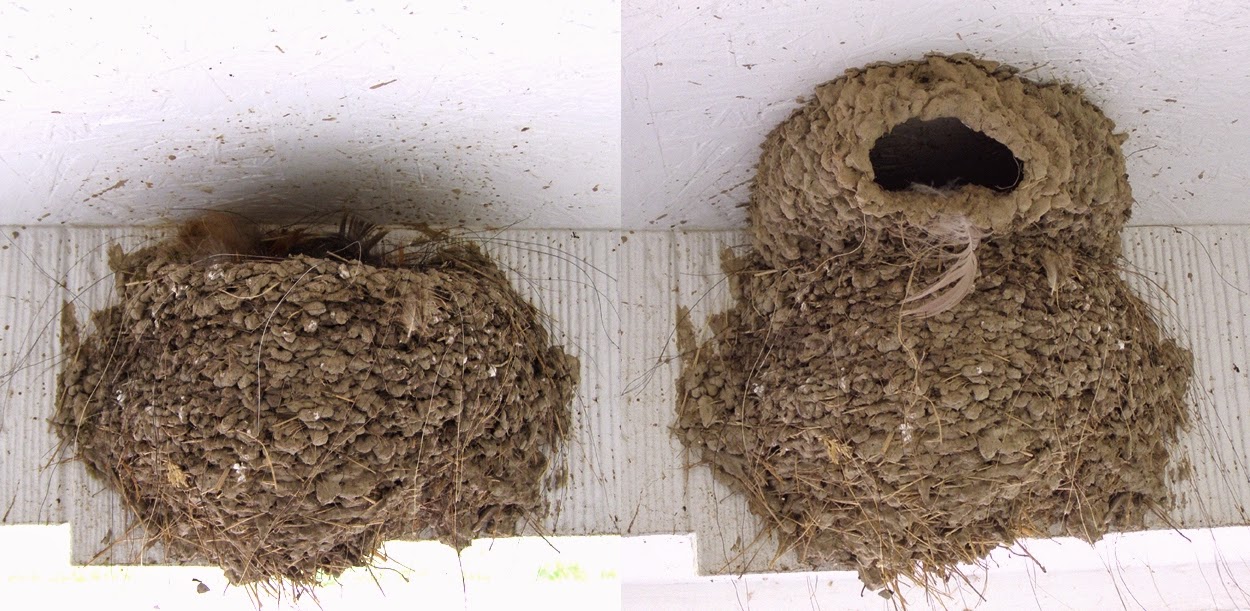
The two swallows ended up creating a dome over the previously bowl-shaped Barn Swallow nest, fashioning the nest into a typical Cliff Swallow type nest.  Below is a "before-and-after" photo.  On the left is the Barn Swallow nest as it appeared in June 2013.  On the right is the way the nest appeared in mid-July 2013 after the Cliff Swallows had finished modifying it.  Quite a difference, would you say?


A Multitude of Cliff Swallows

As the nest was nearing completion, quite a few other Cliff Swallows flew up to the nest seeking entrance via the opening that had been left in the dome.  At times there were as many as six or seven Cliff Swallows simultaneously flying frantically back and forth near my porch ceiling.  But, as each approached the nest to enter it, it would be pecked away, quite viciously I might add, by the male swallow inside the nest.

Once the nest was completed, the male Cliff Swallow would spend all morning inside it.  In quick and jerky motions, he would constantly look up, then down, then to each side, and then repeat these motions over and over again, guarding against those who might want to usurp the nest.

Here is a Cliff Swallow trying to sneak up the side of the nest with the resident male inside.  The male does not yet see the swallow on the side of the nest.  Eventually, however, the sneaking swallow arrived in the vicinity of the entrance hole and was pecked away by the male:


Finally, after several mornings of mob scenes on my porch with many Cliff Swallows seeking entrance to the nest, things seemed to settle down.  Just then we had a heavy rain storm, and water started streaming down through a crack in my bedroom ceiling.  I called my landlord, and he arranged for a roofer to come the following Wednesday and investigate the leak.

A Second Abandonment! 

The roofer came in mid-July and put a ladder right beside the swallow nest.  His use of the ladder to climb to the roof must have frightened the Cliff Swallows because I never saw them again after that day.

Needless to say, I was devastated almost to the point of being severely depressed.  First, the Barn Swallows had rejected the nest.  Then, as if to console me, swallows of a different type had arrived.  But, after working so hard on the nest and completely remodeling it, they, too, had decided to abandon the nest.

Each morning, I would walk around the property searching for swallows -- any type of swallows.  I would see them flying in the air and swooping in the field, but none were showing any interest in either my porch or the well-fashioned nest attached to it.  Even the nest on the adjacent building -- the one on which I had taken pictures of the baby Barn Swallows earlier that month -- was void of swallows.  The babies had left the nest for good and had probably joined the flock by now.

A Blessing of New Birds

On July 29th, I was standing on my porch and gazing at the horse pasture on the neighbor's property adjacent to my driveway.  Suddenly, I sighted a quick flash of a bright, orangish-brown color.  The color looked a little like that of a Robin's breast, but it was much more brilliant.  

A little later, I ventured toward the horse pasture and saw some very unusual-looking tiny birds.  I couldn't figure out what they were because I had never seen birds with those markings.  One bird flew up to the utility wire, and I was able to get a couple of photos of it, one of which is shown below.  I then went inside my apartment, uploaded the photos onto my computer, and proceeded to study them.


All at once, I remembered the flash of bright orange that I had seen in the horse pasture that morning.  Could that have possibly been an Eastern Bluebird?  The last time I had seen any Bluebirds around here had been about 18 years previously when I had first moved here.  During that time period, I would occasionally see a few birds flying between the trees along the local road.  After noticing blue on their wings, I became certain that they were Bluebirds.  But since that time, I had seen no more Bluebirds.

We have only one type of Bluebird in this part of the US, and that is the Eastern Bluebird.  As contrasted with other types of Bluebirds, our Eastern Bluebirds have no blue on their breasts or bellies.  Their breast colors are either burnt orange or a slightly reddish-orange, depending on whether they are males or females.  Their bellies are an off-white color, although the females often tend to have a larger area of off-white than do the males.  The color blue appears only on the head, the back, the wings, and the tail.  And, on the female, this blue tends to be a duller, greyish-blue.  The juveniles will often lack any type of blue at first.  If the juvenile is a male, a brilliant blue will generally first appear on the lower parts of the wings.

I then began to wonder if the tiny birds I had seen and photographed that morning might have been baby Bluebirds.  I went to Google Images and typed in "juvenile bluebird".  After taking some time to study the photos that appeared, I came upon one with the same markings as the bird I had photographed that morning.  That photo had been taken in Antietam, Maryland, a location in the same region of the US in which I reside.

I still was not certain that I had seen baby Bluebirds that morning.  Mentioned on the website with the Antietam photo was a reference to the Maryland Bluebird Society, and I quickly found the Society's Facebook page.  I went ahead and "liked" the page and messaged them with the photo of what I thought might be a juvenile Eastern Bluebird.

Voila!  The Maryland Bluebird Society responded that the photo was indeed of a juvenile Eastern Bluebird.  Joy of joys, I had discovered a bird whose population had been dwindling for many decades!

Now I wanted to find some adults!  On August 4th I took a walk around the property, hoping and praying to find an adult Eastern Bluebird.

A bird suddenly alighted on the utility wire between this building and the adjacent one, but, without binoculars, I was unable to identify it.  I went ahead and photographed it while it stayed on the wire for a few minutes, hoping that my prayers would be answered and that it would indeed be a Bluebird.

And, once I had taken the photos and looked at my camera's previews, I was overjoyed!  It did indeed look like a Bluebird!  This seemed too good to be true.


Soon the bird flew from the wire and toward the woods.  As I was studying the location that seemed to be the bird's destination, a curious thing occurred.  The bird returned from the woods and approached the wire, but this time with another bird!

I peered at the two birds on the wire.  Knowing from my camera's preview that the first bird had an orangish breast, I noticed that the second bird seemed to have an even oranger breast.  The oranger color stood out without my having to photograph the bird.  In fact, I did aim my camera at the pair of birds, but, sadly, this time I was too late.  The two birds flew from the wire before I could snap the shutter.

Later that day, I mustered the courage to again message the Maryland Bluebird Society.  Attaching the photo of the bird on the wire, I was hoping the Society wouldn't find me to be too much of an nuisance.  Thankfully, the Society again responded and told me that the photo showed an adult female Eastern Bluebird!

So, had the female Bluebird on the wire been curious about me?  Had she been lingering on the wire to get a good view of me in order to assess me?  Had she flown away in order to get her mate and bring him back with her for a second opinion?  

I will never know for sure.  But this experience revealed to me that Bluebirds are quite curious about humans.  After all, it is due to human installation of Bluebird nest boxes that the Eastern Bluebird has seemed to make a comeback in its population numbers, at least in some regions of the Eastern US.

So this is how my love of Barn Swallows led me to Bluebirds.  After both the Barn Swallows and the Cliff Swallows had abandoned my porch nest, I had begun venturing outdoors in search of Barn Swallows, in hopes that they would decide to start a late brood on my porch after the Cliff Swallows had left.  But, instead, my search had led to a miracle!  And that miracle was the sighting of Bluebirds for the first time in 18 years!  Thank you, Barn Swallows!

Here are a couple of Bluebird babies in the horse pasture on August 29, 2013:

Why, all of a sudden, were Bluebirds appearing here during the summer of 2013 after many years of invisibility?  Recently, after almost 15 months of seeing my first juvenile Bluebirds, I finally discovered the answer to that question and will offer it in my next blog post.

In the meantime, may Bluebirds of Happiness fill your days!